Arcana Muse
Free printable tarot reference
Tarot Card Meanings Handbook
A field guide to all 78 cards, with concise interpretations, symbol notes, and links back to the full Arcana Muse library.
78 cardsMajor + Minor Arcanaarcanamuse.com
arcanamuse.com
How to use this guide
Start with the image, then the words
This handbook is intentionally compact. It gives you the headline meaning, the symbol notes, and the quickest ways to read the card across love, career, money, and general questions.
Use it as a desk reference, then move to the full article when you want more nuance. Every card page inside this guide links back to the complete Arcana Muse write-up.
What the upright and reversed cues mean
The upright cue is the cleanest expression of the card's energy. The reversed cue shows what happens when that same energy gets blocked, distorted, overdone, or avoided.
If you do not read reversals, treat the reversed note as the shadow pattern to watch for rather than a literal upside-down prediction.
Major Arcana
The big archetypal lessons, turning points, and thresholds of the tarot journey.
22 cards · Full library at arcanamuse.com
Suit of Wands
Drive, ambition, energy, creative momentum, and the way desire moves into action.
14 cards · Full library at arcanamuse.com
Suit of Cups
Emotion, attachment, intuition, belonging, and the vulnerable truth under the surface.
14 cards · Full library at arcanamuse.com
Suit of Swords
Thought, language, conflict, clarity, and the stories the mind keeps telling.
14 cards · Full library at arcanamuse.com
Suit of Pentacles
Money, work, the body, habits, material reality, and what can actually be sustained.
14 cards · Full library at arcanamuse.com
Arcana Muse library
Major Arcana
The big archetypal lessons, turning points, and thresholds of the tarot journey.
Major Arcana · new beginnings
Core keywords
new beginningsspontaneityleap of faith
Reversed shadow
RecklessnessNaivetyHolding back
Upright cue
Upright, The Fool is permission.
Reversed cue
Reversed, The Fool often isn't the opposite of his upright meaning.
What the card is really saying
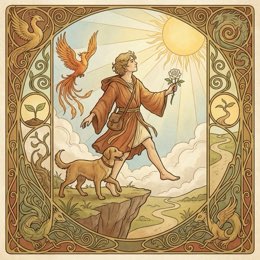
The Fool is card zero, not card one. That detail matters. He exists outside the numbered sequence, before the journey has a number assigned to it. He's standing at a cliff's edge, about to step off, and he's smiling. The little white dog at his heels is either warning him or cheering him on. After thousands of readings, I think it's both.
The imagery is deliberately paradoxical. He carries a small bundle, so he hasn't accumulated much. He's dressed in bright, impractical clothes. The sun shines behind him. He's not stupid. He's unconditioned. He hasn't yet learned all the reasons not to try things. That quality is exactly what makes him powerful and dangerous in equal measure.
Symbols to notice
- The cliff: The risk is obvious. Fool moments are rarely hidden; you usually know you're stepping into uncertainty.
- The white rose: Clean intent, innocence, and a lack of cynicism. The card is less about ignorance than about not being jaded yet.
- The dog: Instinct, protection, or warning. Either way, you're not entering the unknown without a signal system.
Practical advice: Take the next step, not the whole leap.
Reading angles
General
Begin lightly and keep your footing loose.
Love
New attraction needs honesty, not fantasy.
Career
Say yes only if you can stay flexible.
Money
Avoid betting more than you can spare.
Major Arcana · The Fool in readings
Use it in love
Upright: A new relationship with real spark, or an invitation to approach your existing relationship with fresh eyes. Stop performing the relationship you think you should have and show up as yourself, unedited. The Fool in love is exciting and a little terrifying; that's usually a good sign.
Reversed: You may be rushing in without seeing someone clearly, or you're so afraid of getting hurt that you won't let anything start. It can also signal someone in the relationship behaving irresponsibly; making promises they can't keep because they haven't thought things through.
Use it in career and money
Upright: This is the card for starting a new venture, changing careers, or pitching an idea that feels a bit crazy. The Fool says the timing is right even if the plan isn't perfect. In finances, it can indicate some financial risk that turns out well; but only if approached with eyes open.
Reversed: Financial impulsiveness; spending before thinking, investing in something without doing the research, or quitting a job before having another lined up. Slow down. The opportunity will still be there after you've checked the numbers. Career-wise, it can mean avoiding a necessary leap due to fear.
Upright in context
Upright, The Fool is permission. Permission to start before you're ready, to say yes before you have the full plan, to prioritise aliveness over security. This card shows up when life is inviting you into something new: a relationship, a project, a move, a creative direction. The main obstacle is usually your own hesitation. The Fool doesn't wait for guarantees.
Reversed in context
Reversed, The Fool often isn't the opposite of his upright meaning. It's the shadow side of the same energy. Where upright Fool is brave spontaneity, reversed Fool is recklessness dressed as bravery. You're about to step off that cliff without checking whether there's anything below. The impulse is right, but the timing or preparation is off.
Journal prompt
What would you try if nobody were grading you?
Major Arcana · skill and mastery
Core keywords
skill and masterywillpowerresourcefulness
Reversed shadow
ManipulationUntapped potentialDeception
Upright cue
Upright, The Magician is a green light.
Reversed cue
Reversed, The Magician turns his skills toward manipulation rather than mastery.
What the card is really saying
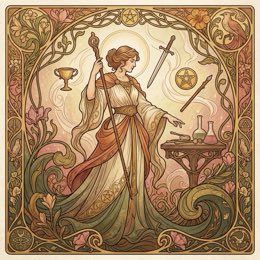
Card one, and the Fool's Journey has immediately escalated. The Magician stands at a table with all four tarot suits laid out; a cup, a wand, a sword, a pentacle. One hand points to the sky, the other to the earth. The famous lemniscate (infinity symbol) floats above his head. He's the conduit between what's possible and what's actual.
The red roses and white lilies surrounding him aren't decorative; red for desire and action, white for purity of purpose. The Magician isn't stumbling around hoping things work out. He's directing energy with precision. What I find striking about this card is how it insists that you already have everything you need. The tools are there. The question is whether you'll pick them up.
Symbols to notice
- The four suit tools: Full access to the deck's elements. Emotion, drive, thought, and material effort are all available.
- One hand up, one hand down: The classic gesture of translating idea into reality. He isn't wishing; he's directing.
- Roses and lilies: Desire paired with discipline. Wanting something is not the same as being ready to handle it well.
Practical advice: Use what you already have before chasing more.
Reading angles
General
Your tools and timing are working together.
Love
Use direct, honest signal instead of charm.
Career
Skill, pitch, and timing can open the door.
Money
Turn existing resources into something useful.
Major Arcana · The Magician in readings
Use it in love
Upright: Someone bringing real skill and intention to the relationship; they know what they want and they're going after it. In a new connection, this is deeply attractive. In an established one, it suggests actively working on the partnership rather than coasting.
Reversed: Watch for someone charming their way through a relationship without meaning what they say. The Magician reversed in love can indicate a persuasive but unreliable partner. It can also mean you're holding back your true self, performing what you think someone wants rather than connecting authentically.
Use it in career and money
Upright: Excellent timing for launching, pitching, negotiating, or taking on a project that requires every skill you have. You're in peak competence right now. Financially, this is a good moment to make strategic moves; you have more leverage than you think.
Reversed: Possible deception in a professional context; read the fine print, don't take flattery for substance. It can also flag that you're not actually using your full capability at work, either because the role doesn't demand it or because you're holding yourself back.
Upright in context
Upright, The Magician is a green light. You have the skills, the resources, and the right timing. What's needed now is concentrated focus. You've prepared enough; now the work is to do it. This card appears when you're capable of something you might be underselling yourself on.
Reversed in context
Reversed, The Magician turns his skills toward manipulation rather than mastery. This doesn't always mean someone is deliberately deceiving you; it can mean someone (possibly you) is using considerable talent in service of the wrong goals. The intelligence is there; the integrity isn't fully aligned with it.
Journal prompt
Which skill or tool are you underusing?
Major Arcana · intuition
Core keywords
intuitioninner knowingmystery
Reversed shadow
Ignoring intuitionSecrets and concealmentWithdrawal
Upright cue
When The High Priestess appears upright, the reading is asking you to go quiet.
Reversed cue
Reversed, The High Priestess often signals a specific problem: you know what the right answer is, and you're not letting yourself act on it.
What the card is really saying
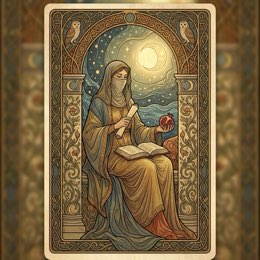
She sits between two pillars; one black, one white; and she isn't explaining herself. The scroll in her lap holds knowledge she hasn't chosen to reveal yet. The card works because she holds something back. The High Priestess is the card of the interior life: what you know beneath the surface, before language gets involved.
The crescent moon at her feet, the pomegranate veil behind her, the cross at her chest; this is a card dense with symbol. She's associated with the subconscious, with cycles, with things that can't be reasoned into existence. She represents the part of you that already knows the answer before you've asked the question. Most people override that knowing with logic. The card asks you to stop overruling that instinct.
Symbols to notice
- The black and white pillars: Duality held in tension. She doesn't collapse complexity into a quick answer.
- The scroll: Private knowledge, not absent knowledge. Something is known here, but not yet spoken out loud.
- The moon and veil: Cycles, privacy, and intuition. The card is asking for deeper attention, not louder thinking.
Practical advice: Wait, listen, and verify.
Reading angles
General
Information is still forming, so stay quiet.
Love
Let trust grow before you force the answer.
Career
Watch what is unsaid in the room.
Money
Do not spend before the facts settle.
Major Arcana · The High Priestess in readings
Use it in love
Upright: Something in this relationship is not yet fully revealed, and that's okay. Don't push for declarations or clarity before the time is right. There's a deepening happening beneath the surface. Trust what you feel rather than what you can prove. This card often appears when a connection has real depth that hasn't been spoken yet.
Reversed: Secrets, withheld feelings, or a partner who isn't being fully honest. It can also indicate that you're not being honest with yourself about what you want from the relationship. Sometimes it shows up when someone is giving more signals than words; and you need to decide whether you trust those signals.
Use it in career and money
Upright: Don't make a major career move or financial decision right now. More information is coming, and acting before it arrives will cost you. This card rewards patience. In creative or research-based work, it's a strong positive sign; your intuition about the direction is correct.
Reversed: You may be missing important details about a financial situation or workplace dynamic. Something is being concealed; possibly unintentionally. Get more information before signing anything or making commitments. It's also a warning against letting imposter syndrome override genuine skill and knowledge.
Upright in context
When The High Priestess appears upright, the reading is asking you to go quiet. Not because there's nothing to act on, but because action right now would be premature. You need more information; and that information isn't going to come from research or other people's opinions. It's going to come from paying attention to what you already feel.
Reversed in context
Reversed, The High Priestess often signals a specific problem: you know what the right answer is, and you're not letting yourself act on it. Maybe it's inconvenient. Maybe it contradicts what you want to be true. But somewhere underneath the noise, you know. The reversal is pointing at the gap between what you know and what you're doing.
Journal prompt
What do you already know but keep ignoring?
Major Arcana · fertility and growth
Core keywords
fertility and growthcreativityabundance
Reversed shadow
Creative blockNeglect of selfSmothering
Upright cue
Upright, The Empress is a strong card for growth, but it still asks for patience.
Reversed cue
Reversed, The Empress often signals creative blockage or a breakdown in the conditions that allow growth.
What the card is really saying
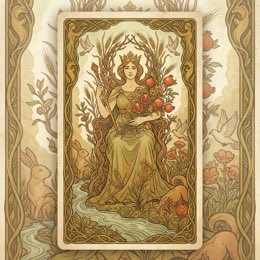
She's seated in a forest, surrounded by wheat, wearing a crown of twelve stars. Everything about The Empress signals abundance in a physical, embodied sense, not abstract wealth, but actual fertility of land, body, and creativity. She doesn't strive. She receives. The natural world around her thrives because of her presence, not her effort.
The Venus symbol on her cushion tells you what kind of power this is: relational, sensory, magnetic. The Empress isn't conquering anything. She's allowing things to grow toward her. This is an underrated form of strength. In a culture that prizes hustle and urgency, The Empress is a reminder that some of the most important things can't be forced; they can only be cultivated.
Symbols to notice
- The wheat: Ripening work and nourishment. The card points to growth you can eventually harvest, not just admire.
- The forest and water: A fertile environment. The Empress asks whether the conditions around your work or relationships actually support growth.
- The crown of stars and Venus imagery: Beauty, attraction, and creation moving through the body rather than through force.
Practical advice: Feed what you want to see grow.
Reading angles
General
Growth needs care, time, and better conditions.
Love
Warmth and attention make the bond grow.
Career
Creativity improves when the environment supports it.
Money
Investment works when the base is healthy.
Major Arcana · The Empress in readings
Use it in love
Upright: A relationship that is genuinely nourishing, or a period of deepening warmth and physical affection. For singles, this card indicates a magnetic quality; you're more attractive right now because you're comfortable in yourself. Pregnancy or family expansion is a common interpretation in literal contexts.
Reversed: Codependency, emotional exhaustion from giving too much, or a relationship that has become stagnant. One person may be smothering the other without realising it. There's also a strand here about not feeling worthy of receiving love; care that flows out but never in.
Use it in career and money
Upright: Creative work is especially favoured. This is a good time for projects that require imagination, beauty, or care; design, writing, hospitality, anything that involves making people feel welcome. Financially, The Empress signals growing prosperity, particularly through patient investment rather than aggressive strategy.
Reversed: Creative burnout or a sense that your work isn't bearing fruit despite real effort. You may be trying too hard or in the wrong direction. Financial reversals often point to overspending on comfort or security without thinking long-term. Reassess where your energy and resources are actually going.
Upright in context
Upright, The Empress is a strong card for growth, but it still asks for patience. She's not promising easy success. She's promising growth if you create the right conditions and then get out of the way. Plant the seed. Water it. Stop pulling it up to check whether it's working.
Reversed in context
Reversed, The Empress often signals creative blockage or a breakdown in the conditions that allow growth. Something you've been trying to cultivate isn't developing. The problem may be the conditions around it, not the thing itself. That might be too much pressure, too little care, or simply the wrong season.
Journal prompt
What needs better care to flourish?
Major Arcana · authority
Core keywords
authoritystructurestability
Reversed shadow
TyrannyRigidityLoss of control
Upright cue
Upright, The Emperor calls for structure.
Reversed cue
Reversed, The Emperor's authority tips into control.
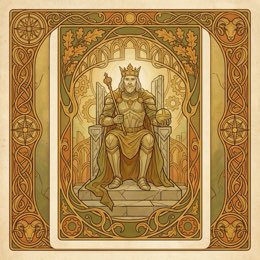
What the card is really saying
He sits on a stone throne decorated with rams; symbols of Aries, of initiative and force. The mountains behind him are barren. This is not a landscape that grows easily. Everything here has been built through will. The Emperor is the archetype of constructed order: not the natural abundance of The Empress, but human-made structure imposed on raw terrain.
The sceptre and orb in his hands represent dominion and the world he governs. His armour under his robe says he hasn't always ruled from a comfortable throne. He knows what it cost to get here. That's what distinguishes genuine authority from entitlement: earned experience, not inherited position. The Emperor at his best is someone who has done the work and now provides stability for others to build within.
Symbols to notice
- The stone throne and mountains: Hard conditions that demand systems, endurance, and clear limits.
- The rams: Aries force in carved form. The Emperor channels raw drive into direction rather than impulse.
- The armor under the robe: Real authority usually comes from prior conflict, not from simply being appointed.
Practical advice: Set the frame before you push ahead.
Reading angles
General
Structure and boundaries will do the heavy lifting.
Love
Clear roles and respect keep things steady.
Career
Take charge and define the rules.
Money
Order the budget before adding more.
Major Arcana · The Emperor in readings
Use it in love
Upright: A relationship with clear structure and security. Someone who shows up consistently, keeps their word, and provides genuine stability. This can be deeply reassuring; or suffocating, depending on what you need. In new relationships, it signals someone who is serious and knows what they want.
Reversed: Control dynamics, emotional unavailability, or a partner who uses authority as a substitute for intimacy. Can also represent an inability to commit to the structure a relationship needs; someone who won't show up consistently or acknowledge what the relationship requires of them.
Use it in career and money
Upright: Strong for career matters; this card favours leadership roles, strategic planning, and situations where someone needs to step up and take charge. Financially, it signals solid planning and disciplined management. Build the foundation. Don't take unnecessary risks right now; consolidate.
Reversed: Power struggles at work, a boss or authority figure causing problems, or your own inability to maintain the discipline your financial situation requires. Reversed Emperor in finances often points to chaos caused by a lack of structure; no budget, no plan, money escaping without tracking.
Upright in context
Upright, The Emperor calls for structure. The Emperor asks a blunt question: do you have a plan and the discipline to keep it? This isn't a card that rewards improvisation. It rewards consistency, follow-through, and the willingness to hold to your own rules even when it's inconvenient. That's harder than it sounds.
Reversed in context
Reversed, The Emperor's authority tips into control. The structure becomes a cage. Rigidity replaces discipline; rules exist to enforce power rather than to create safety. If this represents a person in your life, it's describing someone whose need to control is damaging the relationship or situation around them.
Journal prompt
Where do you need firmer structure?
Major Arcana · tradition
Core keywords
traditioninstitutionsspiritual guidance
Reversed shadow
RebellionQuestioning normsUnconventional path
Upright cue
Upright, The Hierophant often signals that the conventional path is right for this situation.
Reversed cue
Reversed, The Hierophant signals that the conventional approach isn't working and it's time to find your own way.
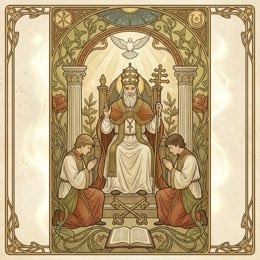
What the card is really saying
He sits between two pillars in ceremonial robes, right hand raised in blessing, two supplicants kneeling before him. The crossed keys at his feet symbolise access to hidden spiritual knowledge. He is the bridge between the divine and the human, the keeper of tradition, the one who says: this is how it has been done, and there are good reasons for that.
Most people misread The Hierophant as simply conservative or oppressive. He's more nuanced. He represents institutional wisdom; the accumulated knowledge that communities have passed down through ritual, tradition, and shared practice. Sometimes that tradition is worth challenging. Sometimes it's worth trusting. The Hierophant doesn't tell you which; he simply represents its presence in your situation.
Symbols to notice
Use the imagery itself as part of the reading; posture, direction, and repeated objects usually carry the message.
Practical advice: Use the standard path if it still fits.
Reading angles
General
A proven path or mentor can help here.
Love
Shared values matter more than novelty.
Career
Learn the system before trying to outsmart it.
Money
Established rules protect the result.
Major Arcana · The Hierophant in readings
Use it in love
Upright: Commitment, marriage, or a relationship moving toward formal recognition. It can also indicate that traditional relationship structures; monogamy, defined roles, long-term partnership; are what this relationship needs and wants. Meeting a partner through shared beliefs or community is another common reading.
Reversed: A relationship that breaks social norms, or a need to define the relationship on your own terms rather than following convention. It can also indicate conflict between what society or family expects and what you actually want from partnership. This reversal often shows up when someone is coming out or redefining relationship structures.
Use it in career and money
Upright: Working within established institutions; corporations, academic settings, government, organised religion. The conventional career path is favoured right now. Financial advice from an established, credentialled source is reliable. Following the established process will get you where you need to go more reliably than improvising.
Reversed: Entrepreneurship, freelancing, or working outside conventional structures. The system isn't serving your career needs, and you may need to build your own. Financially, it can warn against following conventional advice that doesn't fit your actual situation, or excessive reliance on institutions that are fundamentally misaligned with your values.
Upright in context
Upright, The Hierophant often signals that the conventional path is right for this situation. Not because you must conform, but because the established approach has genuine merit here. This might mean working within an institution rather than against it, following a mentor's advice, or formalising something that's been informal; a commitment, a process, an agreement.
Reversed in context
Reversed, The Hierophant signals that the conventional approach isn't working and it's time to find your own way. The institution or tradition in question may be corrupt, outdated, or simply not suited to your actual situation. This is the card of the genuine iconoclast, not rebellion for its own sake, but a principled departure from structures that no longer serve.
Journal prompt
Which teacher, system, or rule is actually useful?
Major Arcana · love and union
Core keywords
love and unionalignment of valuesimportant choice
Reversed shadow
MisalignmentPoor choicesConflict of values
Upright cue
Upright, The Lovers signals a moment of genuine alignment; with another person, with a path, with your own values.
Reversed cue
Reversed, The Lovers often represents a relationship or situation where the values are genuinely out of alignment.
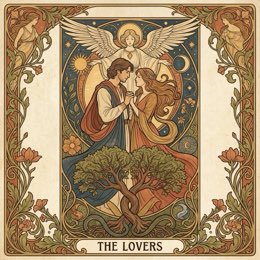
What the card is really saying
Two figures stand beneath an angel; one with a tree of flame, one with a tree of knowledge. The angel watches from above. This isn't a card of easy romance; it's a card about standing at a crossroads with your whole self on the line. The choice being made here isn't just about another person. It's about what kind of life you want to live.
Most people read The Lovers as simply "romance incoming." That's too shallow. The card is about alignment; between people, between your desires and your values, between who you are and who you're choosing to become through your choices. The angel overhead isn't blessing the union; he's witnessing the decision. That distinction matters.
Symbols to notice
Use the imagery itself as part of the reading; posture, direction, and repeated objects usually carry the message.
Practical advice: Name the values before making the choice.
Reading angles
General
Alignment matters more than appearance.
Love
The relationship works only if values line up.
Career
Choose the path that fits your principles.
Money
Money choices should match your priorities.
Major Arcana · The Lovers in readings
Use it in love
Upright: Strong romantic connection, genuine chemistry, or a relationship that's moving toward greater commitment because the values are genuinely aligned. This is the card that actually means what people hope The Lovers means; a real, reciprocal, soul-level connection. Trust it.
Reversed: A relationship where something fundamental doesn't fit. Not a small incompatibility but a real values misalignment. It can also indicate a love triangle or situation where someone is torn between two people or between a relationship and another life choice. Something has to give.
Use it in career and money
Upright: A career decision that aligns with your deepest values, not just the logical next step, but the path that actually feels right. Sometimes this card appears at a fork in the road between financial security and meaningful work. The Lovers upright says: go with what's genuinely aligned, even if it's harder.
Reversed: Work or financial choices made for the wrong reasons; prestige, fear, or what others expect rather than what you actually value. A business partnership with fundamental incompatibilities. The reversal asks whether you've made financial decisions that require you to compromise who you are.
Upright in context
Upright, The Lovers signals a moment of genuine alignment; with another person, with a path, with your own values. There's something here that feels right at a deep level, not just a surface attraction. When this card appears it's often asking you to trust that alignment rather than overthinking it or letting fear make the choice for you.
Reversed in context
Reversed, The Lovers often represents a relationship or situation where the values are genuinely out of alignment. Not just disagreement; genuine incompatibility that can't be talked away. This card reversed asks you to be honest about whether what you want and what this person or path offers are actually compatible.
Journal prompt
What choice best matches your values?
Major Arcana · victory
Core keywords
victorywillpowerdetermination
Reversed shadow
Lack of directionAggressionLoss of control
Upright cue
Upright, The Chariot signals victory through sustained effort and focused will.
Reversed cue
Reversed, The Chariot's focused drive becomes scattered or misdirected.
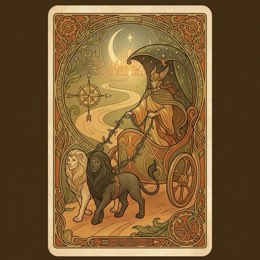
What the card is really saying
A warrior stands in a chariot pulled by two sphinxes; one black, one white; pointing in different directions. He has no reins. He controls them through sheer will and focused intention. The star canopy above him, the armour covered in crescent moons, the walled city behind him; he has come from somewhere and he is going somewhere. This is not a card of passive receiving. This is active conquest.
The two sphinxes pulling in opposite directions are the key symbol. They represent the conflicting forces that always exist in any serious pursuit; desire and reason, excitement and caution, personal needs and external demands. The Chariot's power isn't in eliminating these tensions; it's in harnessing them. You don't win by having no internal conflict. You win by not letting that conflict stop you.
Symbols to notice
Use the imagery itself as part of the reading; posture, direction, and repeated objects usually carry the message.
Practical advice: Pick a direction and stay with it.
Reading angles
General
Focused effort can carry the situation.
Love
Keep direction clear if you want the bond to move.
Career
Discipline and drive can win this round.
Money
Steady control beats scattered effort.
Major Arcana · The Chariot in readings
Use it in love
Upright: Someone who pursues what they want with confidence and clarity. In a relationship, this card often signals movement; a relationship progressing to the next stage, or someone actively showing up for the relationship with determination. Both people are moving in the same direction with shared purpose.
Reversed: Control issues, competing agendas, or someone who needs to win every argument. The energy in the relationship has become combative. It can also indicate a relationship stalling because neither person is willing to take decisive action; both waiting for the other to drive.
Use it in career and money
Upright: Strong ambition paying off. A promotion, a project completion, a business milestone reached through sustained effort. This is one of the best cards for career achievement, not lucky breaks but earned success. Financially, disciplined focus on a financial goal is working. Keep the pressure on.
Reversed: Work burnout from too much force for too long without rest. Or a career path that's become about winning rather than meaning. Financially, impulsive spending driven by a need to feel in control, or financial goals that keep shifting before any are achieved.
Upright in context
Upright, The Chariot signals victory through sustained effort and focused will. This isn't lucky success; it's earned success. The card shows up when you need to push through resistance, maintain discipline despite setbacks, and refuse to let obstacles define what's possible. The asking is not "do you want to win?" but "are you willing to do what winning actually requires?"
Reversed in context
Reversed, The Chariot's focused drive becomes scattered or misdirected. The sphinxes are pulling apart and you can't hold them. Energy is high but directionless; lots of activity without progress. Or the opposite: you're stuck, knowing where you want to go but unable to mobilise. Either way, control has been lost.
Journal prompt
What would focused effort look like now?
Major Arcana · inner strength
Core keywords
inner strengthcompassionpatience
Reversed shadow
Self-doubtWeaknessInsecurity
Upright cue
Upright, Strength is a reminder that the most powerful thing you can do right now is refuse to be ruled by your most reactive impulses.
Reversed cue
Reversed, Strength points to a failure of that inner composure.
What the card is really saying
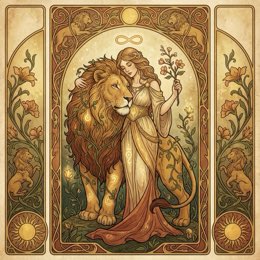
A woman in white gently closes the mouth of a lion. Not forcing it; taming it. The infinity symbol above her head is the same as The Magician's, but where The Magician's magic is directed outward, Strength's mastery is directed inward. She has flowers in her hair. She looks perfectly calm. The lion is not her enemy; it's the part of herself she has learned to work with rather than against.
The lion represents raw instinct, fear, anger, desire; the primitive forces that can run us if we let them. Strength doesn't eliminate those forces. She acknowledges them, works with them, directs them. That's what real inner strength looks like: not suppression, but integration. Not the absence of fear, but action despite it.
Symbols to notice
Use the imagery itself as part of the reading; posture, direction, and repeated objects usually carry the message.
Practical advice: Use restraint where you want to use force.
Reading angles
General
Quiet control works better than force.
Love
Patience and kindness keep things from snapping.
Career
Composure under pressure is the advantage.
Money
Resist impulse and keep your cool.
Major Arcana · Strength in readings
Use it in love
Upright: A relationship that requires patience and emotional maturity; and you have it. This card shows up when a partnership is going through something hard and the answer is steadiness, not ultimatums. It can also describe someone whose gentle confidence is genuinely attractive. Strength in love is about showing up calmly in the middle of difficulty.
Reversed: Insecurity showing up as control or emotional reactivity. Someone in the relationship (possibly you) is letting fear drive their behaviour; jealousy, anxiety, withdrawal. The reversal asks where your confidence in this relationship is actually coming from, and whether it's yours or dependent on the other person's constant reassurance.
Use it in career and money
Upright: The ability to handle a challenging work situation with grace under pressure. A difficult colleague, a high-stakes project, a leadership challenge; Strength says you have the internal resources to navigate it. Financially, it signals the discipline to maintain long-term goals when short-term temptation is present.
Reversed: Losing your nerve when steadiness was needed. Caving to workplace pressure rather than holding your position, or abandoning a financial plan at the first sign of difficulty. The question is whether what's undermining you is external pressure or internal doubt; usually it's both, but one is the driver.
Upright in context
Upright, Strength is a reminder that the most powerful thing you can do right now is refuse to be ruled by your most reactive impulses. You have the capacity to respond rather than react. That's harder and rarer than it sounds. Whatever situation you're asking about, this card says the answer isn't more force; it's more composure.
Reversed in context
Reversed, Strength points to a failure of that inner composure. You may be letting fear or insecurity dictate your choices. Or you're suppressing something rather than integrating it; which always means it will surface elsewhere, with less control, at the worst possible moment. The reversed card asks what you've been refusing to face directly.
Journal prompt
Where would steadiness beat intensity?
Major Arcana · soul-searching
Core keywords
soul-searchingsolitudeinner guidance
Reversed shadow
IsolationLonelinessWithdrawal from life
Upright cue
Upright, The Hermit is calling for a period of genuine reflection.
Reversed cue
Reversed, The Hermit's healthy solitude has tipped into isolating withdrawal.
What the card is really saying
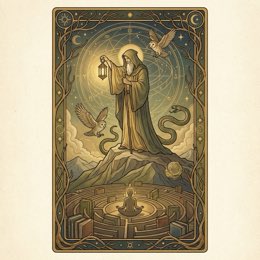
He stands alone on a mountain peak, wrapped in a grey cloak, lantern raised. The lantern holds a six-pointed star, a sign of wisdom earned the hard way and carried high enough to guide other people. His staff grounds him. He has reached the top, but he is still moving, still seeking. The Hermit knows the inner journey does not end with one neat arrival.
The Hermit isn't depressed or cut off for the sake of it. He's alone by design because the work in front of him can only be done alone. This card belongs to the real seeker, the person who steps away from noise and distraction long enough to work out what they actually believe. That work matters. Most people just put it off.
Symbols to notice
Use the imagery itself as part of the reading; posture, direction, and repeated objects usually carry the message.
Practical advice: Make space to think without interruption.
Reading angles
General
Solitude can reveal the answer.
Love
Step back before you confuse loneliness with truth.
Career
A private review will be more useful than noise.
Money
Pull back and check the numbers yourself.
Major Arcana · The Hermit in readings
Use it in love
Upright: A period where you need time alone to understand what you want from connection. This doesn't have to mean ending a relationship, but it does mean creating genuine space for self-reflection. If you're single, The Hermit often signals that now is a time for inner clarity rather than active searching.
Reversed: Isolation in a relationship; emotional unavailability, partners who have retreated from each other, or someone who has withdrawn into themselves in ways that are damaging the connection. It can also warn against choosing loneliness over the vulnerability of genuine connection.
Use it in career and money
Upright: A period of research, study, or deliberate preparation rather than active career movement. This isn't stagnation; it's strategic withdrawal to develop expertise or clarity about direction. Financially, careful assessment and conservative planning rather than big moves. Knowledge is the best investment right now.
Reversed: Excessive caution that has become paralysing, or someone so focused on solo work that they're missing collaboration opportunities. Financially, hoarding or extreme frugality that crosses into withholding from yourself. Or the opposite: complete disengagement from financial planning because looking at it feels too uncomfortable.
Upright in context
Upright, The Hermit is calling for a period of genuine reflection. Not a day off, not a weekend retreat, but real inward attention. Something in your life requires you to go quiet and listen to yourself without distraction. The answers you're looking for aren't going to come from other people, more research, or more activity. They're going to come from stillness.
Reversed in context
Reversed, The Hermit's healthy solitude has tipped into isolating withdrawal. The distinction matters. Upright, The Hermit steps back to find himself. Reversed, he disappears to avoid other people or the world itself. Loneliness disguised as spiritual practice. Avoidance dressed up as introversion.
Journal prompt
What does quiet let you hear?
Major Arcana · unexpected change
Core keywords
unexpected changeluckadaptation
Reversed shadow
bad timingstagnationresistance
Upright cue
When upright, the Wheel of Fortune doesn't ask permission to shake things up; it just does.
Reversed cue
Reversed, the Wheel grinds to a halt.
What the card is really saying
The Wheel of Fortune is a reminder that not everything is up to you. Things shift; often rapidly; and sometimes the only skill worth having is the ability to respond without clinging to the old script. This isn't a card about engineering your outcome, but about reading the room and noticing which way the wind is blowing.
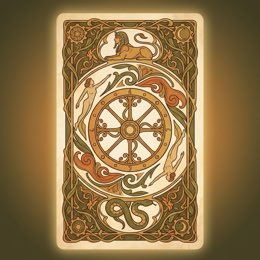
Imagery of the spinning wheel, mythic beasts, and elemental figures underscores that luck; good or bad; isn't purely random, but bound up with structure and history. You can't out-plan the wheel, but you can decide how you'll ride it.
Symbols to notice
Use the imagery itself as part of the reading; posture, direction, and repeated objects usually carry the message.
Practical advice: Adapt quickly instead of clinging to the old pattern.
Reading angles
General
The cycle is already turning.
Love
Timing changes the relationship more than willpower does.
Career
A shift in conditions can change the result.
Money
Ups and downs are part of the cycle.
Major Arcana · Wheel of Fortune in readings
Use it in love
Upright: Expect the unexpected; relationships might suddenly blossom, fizzle, or take a sharp turn. Whether this is a new beginning or abrupt ending, adaptability matters more than plans. Sparks and surprises rule the moment.
Reversed: You're likely stuck replaying the same arguments or attracting the same dead ends. Reversed, this card warns against clinging to people or patterns just because they're familiar. Stagnant love rarely improves by itself.
Use it in career and money
Upright: Sudden changes at work; new roles, surprise opportunities, layoffs, or twists of fate; demand on-your-feet thinking. Ride the momentum, don't waste time mourning the old order, and look for hidden upsides.
Reversed: The office feels like Groundhog Day: projects stall, promotions slip away, and you can't seem to catch a break. It may be time to rethink your approach, or stop expecting luck to rescue you from a dead zone.
Upright in context
When upright, the Wheel of Fortune doesn't ask permission to shake things up; it just does. Doors open and close with little warning, and your job is to pivot fast. There's no guarantee things will go your way, but odds improve if you're nimble and attentive.
Reversed in context
Reversed, the Wheel grinds to a halt. You may feel stuck in a rut, running in place, or suffering just plain bad luck; especially if you keep resisting what needs to change. Trying to force your old routine is about as effective as yelling at the weather.
Journal prompt
What cycle is already turning?
Major Arcana · accountability
Core keywords
accountabilitytruthconsequences
Reversed shadow
biasdishonestyavoidance
Upright cue
Upright Justice means fair outcomes; issues resolve according to evidence, not who's loudest or most charming.
Reversed cue
Reversed, Justice points to slanted scales; delays, red tape, or someone stacking the deck.
What the card is really saying
Justice isn't interested in excuses or stories; it wants the facts and the receipts. This card means what you've put out into the world is returning, and there's no room for dodging responsibility. If you've acted with integrity, expect clarity and fairness; if you've cut corners, expect exposure.
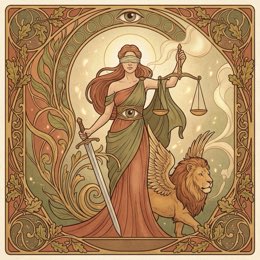
The sword in her hand isn't for show. It reminds you that every action lands somewhere specific, and the scales track the details. There's no need for anxiety if you've been upright, but don't expect mercy if you've been playing dirty.
Symbols to notice
Use the imagery itself as part of the reading; posture, direction, and repeated objects usually carry the message.
Practical advice: Own your part and verify the details.
Reading angles
General
Facts, fairness, and consequences matter now.
Love
Honesty needs to outweigh convenience.
Career
A clear decision should stand on evidence.
Money
Check the record before you sign or spend.
Major Arcana · Justice in readings
Use it in love
Upright: In relationships, upright Justice brings honest conversations and decisions based on mutual respect. If things have been off-balance, this card calls for accountability and realignment.
Reversed: Reversed, Justice suggests one-sidedness; maybe you're giving more than you get, or dealing with dishonesty. Don't gloss over the red flags; call out double standards before they fester.
Use it in career and money
Upright: At work, upright Justice favors fair evaluations and well-earned promotions. Legal matters or workplace disputes tend to resolve correctly; provided your documentation is solid.
Reversed: Reversed, Justice spells bias, office politics, or someone taking shortcuts. Don't expect recognition if you haven't backed up your claims, and watch for hidden agendas.
Upright in context
Upright Justice means fair outcomes; issues resolve according to evidence, not who's loudest or most charming. This is the time for transparency: contracts, disputes, or tough conversations swing in your favor when your intentions and actions pass scrutiny.
Reversed in context
Reversed, Justice points to slanted scales; delays, red tape, or someone stacking the deck. You might be tempted to fudge the truth to avoid consequences, but the fallout will catch up eventually.
Journal prompt
What outcome would be fair, not just easy?
Major Arcana · pause
Core keywords
pausesacrificenew perspective
Reversed shadow
stallingindecisionresistance
Upright cue
Upright, The Hanged Man says to drop the struggle and look at things from a different angle; even if that means admitting you've been wrong.
Reversed cue
Reversed, The Hanged Man is stuck in limbo, refusing to learn what suspension is trying to teach.
What the card is really saying
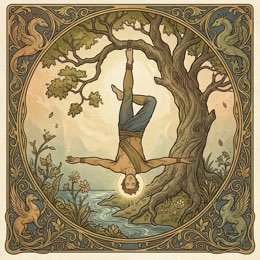
The Hanged Man refuses to move forward on anyone's terms but his own, suspending action to invite insight. Hanging by one foot and gazing downward, he challenges you to stop pushing and embrace a period of enforced stillness; even if it means letting go of something you wanted.
This card doesn't promise resolution, and it certainly doesn't care about your timeline. It suggests that the only sane response to gridlock is to change your angle, loosen your grip, and allow uncomfortable truths to surface, even if that means making a sacrifice that no one else understands.
Symbols to notice
Use the imagery itself as part of the reading; posture, direction, and repeated objects usually carry the message.
Practical advice: Stop pushing long enough to see differently.
Reading angles
General
Pause and look at it from another angle.
Love
Waiting may reveal what pursuit will not.
Career
A delay could be asking for a different approach.
Money
Hold still until the numbers make sense.
Major Arcana · The Hanged Man in readings
Use it in love
Upright: Romantic situations are on hold, whether you like it or not. Viewing your partner; or your dating patterns; from a radically different lens is required, even if it's uncomfortable.
Reversed: You're prolonging relationship problems by refusing to see things differently or make the needed sacrifice. Clinging to the old script guarantees the status quo remains.
Use it in career and money
Upright: The Hanged Man upright in your career means progress stalls until you let go of control and reconsider your approach. This is the time for patience, recalibration, and, yes, some humility.
Reversed: You're spinning your wheels at work by doubling down on what's not working. Your refusal to yield or try a new perspective is costing you opportunities.
Upright in context
Upright, The Hanged Man says to drop the struggle and look at things from a different angle; even if that means admitting you've been wrong. His message isn't about laziness or passivity; it's about choosing to stop pushing against a door that won't open.
Reversed in context
Reversed, The Hanged Man is stuck in limbo, refusing to learn what suspension is trying to teach. His upside-down view becomes pointless when you insist there's nothing new to see.
Journal prompt
What changes when you stop forcing it?
Major Arcana · endings
Core keywords
endingstransformationrelease
Reversed shadow
resistancestagnationfear of change
Upright cue
Death's main message: say goodbye and mean it.
Reversed cue
Drawn reversed, Death stares you down: what are you refusing to let die?
What the card is really saying
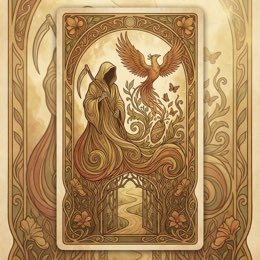
A skeletal figure on horseback advances, trampling wasteland and crowned with inevitability; this card pulls no punches. Death is about clean breaks, the non-negotiable end of a cycle, and the uncomfortable relief that follows when dead weight is finally cut loose.
The scene is unsentimental: loss happens, doors slam shut, and something long overdue is finally finished. Whether you surrender or fight it, Death strips away what can't last; leaving a blank slate, and perhaps, a rare sense of honesty.
Symbols to notice
Use the imagery itself as part of the reading; posture, direction, and repeated objects usually carry the message.
Practical advice: Let the ending be real.
Reading angles
General
Something is finished and needs to be released.
Love
An old form cannot be carried forward unchanged.
Career
End what is over so the next stage can begin.
Money
Clear away what no longer has value.
Major Arcana · Death in readings
Use it in love
Upright: If you're clinging to a relationship that's already flatlined, Death pushes you to break ties. Singles may finally shed stale patterns, clearing the way for something (or someone) authentic.
Reversed: Hanging on to old wounds or exes? The reversed card warns of misery caused by never truly finishing what's been over for ages. Only honesty will let you move forward.
Use it in career and money
Upright: Work situations that need to end; projects, jobs, partnerships; are on the chopping block. Don't drag out a bad fit; closing one door is the only way another opens.
Reversed: Fearing the consequences of quitting or changing course leaves you stuck in workplace purgatory. The longer you hesitate, the messier the fallout.
Upright in context
Death's main message: say goodbye and mean it. When you stop dragging the carcass of a situation that's gone cold, its absence creates room for something non-rotten.
Reversed in context
Drawn reversed, Death stares you down: what are you refusing to let die? Sometimes the hardest part isn't the ending, but the refusal to accept it.
Journal prompt
What are you still carrying past its end?
Major Arcana · balance
Core keywords
balancemoderationpatience
Reversed shadow
imbalanceexcessdiscord
Upright cue
You're being nudged to approach situations methodically; no impulsive moves, no chasing silver bullets.
Reversed cue
The reversed Temperance shows a sloppy hand at the wheel; you're either all-in or all-out, ignoring any middle ground.
What the card is really saying
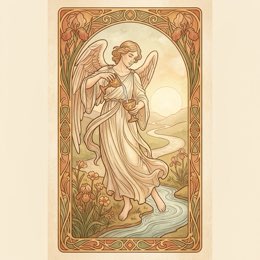
Temperance is the card of practical solutions and measured steps. The robed angel straddles land and water, pouring between two cups; nothing wasted, nothing rushed. You're being shown that the answer you need isn't dramatic; it's a careful mix, an honest assessment of what's actually sustainable for the long haul.
This card asks you to edit your habits, cut out the noise, and experiment with what brings real calm or progress, not just immediate gratification. It expects you to keep your cool, even when everyone else is losing theirs, and to stay disciplined in your actions instead of seeking quick fixes.
Symbols to notice
Use the imagery itself as part of the reading; posture, direction, and repeated objects usually carry the message.
Practical advice: Blend, test, and adjust instead of rushing.
Reading angles
General
Balance comes from patient mixing, not extremes.
Love
The bond needs pacing and mutual adjustment.
Career
Combine strengths instead of forcing one answer.
Money
Moderation protects the long game.
Major Arcana · Temperance in readings
Use it in love
Upright: Slow and steady wins here. Emotional balance and mutual compromise are needed, not whirlwind romance or dramatic gestures. If you're partnered, honest conversations and gradual adjustments bring real growth.
Reversed: Arguments flare up, or feelings run hot and cold. Either you or your partner are giving too much or too little; if you want this to work, find the middle ground, and fast.
Use it in career and money
Upright: This is about teamwork and mixing skills for the common good. Blend your strengths with others and avoid office drama; incremental improvements beat power plays every time.
Reversed: Disorganization, turf wars, or out-of-control ambitions could be sinking the ship. Pull back from extremes, get your routines in order, and stop trying to do it all yourself.
Upright in context
You're being nudged to approach situations methodically; no impulsive moves, no chasing silver bullets. This isn't a time for extremes, and if you're mixing conflicting goals, Temperance gives you the green light to blend them into something useful.
Reversed in context
The reversed Temperance shows a sloppy hand at the wheel; you're either all-in or all-out, ignoring any middle ground. Bad habits or overindulgence could be destabilizing what you're trying to manage.
Journal prompt
What needs blending rather than choosing sides?
Major Arcana · addiction
Core keywords
addictionmaterialismtemptation
Reversed shadow
releasebreaking freeself-awareness
Upright cue
There are no excuses left; The Devil is the part of you that knows exactly which habits are hurting you, and how you rationalize them.
Reversed cue
Reversed, The Devil represents the first cracks in the armor of self-sabotage.
What the card is really saying
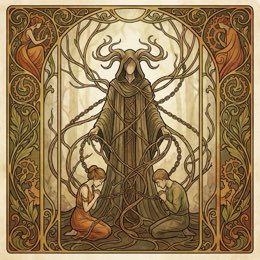
The Devil shows two naked figures chained to a pedestal, but look closer; those chains hang loose enough for escape. This card cuts through denial, forcing you to confront compulsions and harmful attachments. It's a wake-up call to recognize what you're giving your power away to: substances, obsessions, toxic relationships, or your own limiting beliefs.
The Devil's imagery is direct: he points to indulgence and the lies we tell ourselves. You might be stuck, but you're not powerless. The card's challenge is harsh: will you keep feeding your demons, or will you finally stare them down and walk free?
Symbols to notice
Use the imagery itself as part of the reading; posture, direction, and repeated objects usually carry the message.
Practical advice: Name the pattern before it names you.
Reading angles
General
A pattern of attachment is costing you.
Love
Desire is becoming a trap or excuse.
Career
Pressure, habit, or status may be running you.
Money
Debt, fear, or craving needs a hard look.
Major Arcana · The Devil in readings
Use it in love
Upright: In love, The Devil points to relationships driven by obsession, lust, or unhealthy dependency. Boundaries are blurred, power games emerge, and staying stuck might feel easier than facing the truth.
Reversed: When reversed, The Devil signals the courage to break free from toxic dynamics or codependency. It's the hard work of reclaiming self-respect and demanding honesty; even if it means ending the connection.
Use it in career and money
Upright: Work under The Devil can mean selling out for a paycheck, feeling trapped in a soul-sucking job, or cutting corners to get ahead. Be honest about what you're willing to trade and whether the money's worth the moral hangover.
Reversed: The Devil reversed in career readings suggests you're ready to quit the rat race, end an exploitative contract, or confront your own burnout. Don't expect applause; your freedom will come from your own conviction.
Upright in context
There are no excuses left; The Devil is the part of you that knows exactly which habits are hurting you, and how you rationalize them. Beware anything that feels irresistible, because behind the pleasure lies the cost.
Reversed in context
Reversed, The Devil represents the first cracks in the armor of self-sabotage. Maybe you're recognizing the game, or maybe you finally admit what's been controlling you. Change starts when you spot the lie.
Journal prompt
What habit or deal is costing more than it gives?
Major Arcana · upheaval
Core keywords
upheavalrevelationsudden change
Reversed shadow
denialdelayed disasteravoiding truth
Upright cue
The Tower upright is the rude awakening, the mask ripped away, the truth you can't ignore.
Reversed cue
The Tower reversed means the disaster is still hovering, but you're ducking it; or pretending nothing's wrong even as cracks spread.
What the card is really saying
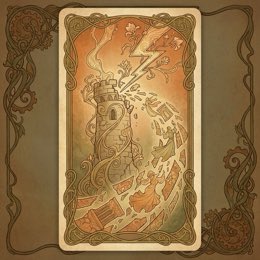
The Tower rips away false security: lightning strikes, the crown topples, and everything you thought was solid falls apart in an instant. There's no sugarcoating it; the card means things are breaking down, often with a blast that leaves no doubt what's been lost.
But this isn't chaos for its own sake. Those crashing figures are being ejected from a prison that needed to fall. The destruction is total, yes, but what remains is room to build something real, stripped of illusion and pretense. Cling to the ruins and you'll get buried; face the truth and rebuild smarter.
Symbols to notice
Use the imagery itself as part of the reading; posture, direction, and repeated objects usually carry the message.
Practical advice: Get honest fast and secure what matters.
Reading angles
General
A false structure is breaking open.
Love
Shock can clear away a fragile illusion.
Career
What looked stable may not have been.
Money
Protect the essentials and expect disruption.
Major Arcana · The Tower in readings
Use it in love
Upright: Old relationships collapse, secrets come out, or a sudden breakup shatters illusions. The pain is real, but honesty and a fresh start follow the wreckage.
Reversed: You're patching holes in a partnership that's already unstable or ignoring warning signs. Face what's falling apart; otherwise, you'll just prolong the hurt.
Use it in career and money
Upright: Job loss, corporate shakeups, or shocking revelations hit the workplace. Let yourself grieve, then use the clearing to pursue a truer path.
Reversed: Avoiding layoffs or clinging to a doomed project drags out stress and chaos. Take initiative to cut ties cleanly, or you'll be caught in the collapse anyway.
Upright in context
The Tower upright is the rude awakening, the mask ripped away, the truth you can't ignore. Trust that what collapses needed to go, no matter how ugly the fallout gets.
Reversed in context
The Tower reversed means the disaster is still hovering, but you're ducking it; or pretending nothing's wrong even as cracks spread. This is denial, not safety.
Journal prompt
What part of this was never solid?
Major Arcana · hope
Core keywords
hopeclarityrenewal
Reversed shadow
disillusionmentpessimismstalling
Upright cue
Upright, The Star calls for transparency and practical hope: look at your situation with sober eyes, then commit to rebuilding.
Reversed cue
Reversed, The Star turns sour: hope dries up, trust feels like a bad joke, and you may be clinging to empty promises.
What the card is really saying
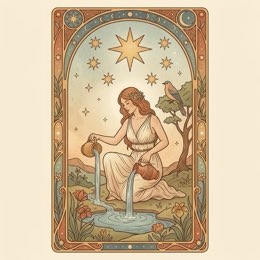
The Star lands after The Tower's devastation, calm, steady, and unapologetically transparent. The naked figure does not hide behind symbols. She pours out what she has because she trusts there is enough left to keep going. Here, hope looks like the slow, honest work of refilling a well that has run dry. When The Star appears, you need to face facts and still leave room for improvement.
The Star is about slowly reconstructing faith in yourself and your future, one honest admission or brave choice at a time. Wishing alone won't get you there. You have to pick up the jug and start pouring, even if your hands shake. This card rewards transparency, realism, and patience.
Symbols to notice
Use the imagery itself as part of the reading; posture, direction, and repeated objects usually carry the message.
Practical advice: Keep the goal visible and make it practical.
Reading angles
General
Recovery starts with clear, steady hope.
Love
Openness and trust can rebuild what broke.
Career
A calmer plan will work better than panic.
Money
Rebuild slowly and measure progress.
Major Arcana · The Star in readings
Use it in love
Upright: In relationships, The Star favors rebuilding trust after a fallout; no manipulation, no secrets. If you're single, it's a push to show up authentically and heal old baggage instead of chasing a fantasy.
Reversed: Romantic hope has corroded into cynicism, or you might be sabotaging a good thing by expecting perfection. Stop outsourcing your happiness to future partners or fairy tale outcomes.
Use it in career and money
Upright: Work-wise, The Star is about slow, steady restoration; returning to basics and finding new optimism after burnout or failure. Own your mistakes and propose solutions, not excuses.
Reversed: You may be stagnating at work or doubting your path because nothing is changing. False promises from leadership or your own lack of follow-through are keeping you stuck; it's time for a reality check.
Upright in context
Upright, The Star calls for transparency and practical hope: look at your situation with sober eyes, then commit to rebuilding. You're past the disaster zone, but you aren't finished. Keep moving with honesty and a workable plan. Healing starts with clear water, not murky intentions.
Reversed in context
Reversed, The Star turns sour: hope dries up, trust feels like a bad joke, and you may be clinging to empty promises. This card warns against drifting into apathy or waiting for a cosmic rescue that simply won't come. The nakedness feels exposed and vulnerable rather than free.
Journal prompt
What would make hope feel concrete again?
Major Arcana · illusion
Core keywords
illusionuncertaintyintuition
Reversed shadow
clarityunveilingconfusion
Upright cue
Upright, The Moon shows a time of murky circumstances and unreliable cues.
Reversed cue
When reversed, The Moon breaks through the haze.
What the card is really saying
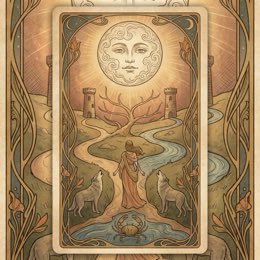
The Moon in a reading means you're moving through fog. Not everything is as it appears; motives, information, and even your own instincts could be twisted by fear or fantasy. Like the beasts baying at the moon, you might sense threats that aren't there or overlook real risks lurking just out of sight.
This card pushes you to rely on intuition, but with a sharp eye on what might be distortion. Dreams, memories, and gut feelings can guide you, but take nothing at face value. The Moon insists on patience; act now and you may stumble blindly into trouble.
Symbols to notice
Use the imagery itself as part of the reading; posture, direction, and repeated objects usually carry the message.
Practical advice: Slow down and sort signal from noise.
Reading angles
General
The picture is unclear, so verify before acting.
Love
Mixed signals need time and confirmation.
Career
Read between the lines, but check the facts.
Money
Do not trust a plan you cannot explain.
Major Arcana · The Moon in readings
Use it in love
Upright: In love, The Moon warns that you're not seeing everything. Someone may be masking their feelings or you're projecting insecurities onto each other. Slow down and refuse to jump to conclusions; clarity will take time.
Reversed: The Moon reversed often brings out a truth: misunderstandings clear, secret crushes get revealed, or one partner's fears are finally discussed. Don't expect bliss overnight, but honest dialogue is now on the table.
Use it in career and money
Upright: At work, The Moon upright means you're working with partial info: office politics, missing details, or vague job roles. Navigate carefully, and trust your hunches; but demand receipts before acting.
Reversed: Reversed, this card can point to the end of confusion or secretiveness at work. Expect facts to emerge or rumors to get debunked, but double-check everything before you take a big leap.
Upright in context
Upright, The Moon shows a time of murky circumstances and unreliable cues. False friends, incomplete facts, and your own anxieties could all be muddying the waters. Don't force decisions; keep digging, but don't let paranoia run the show.
Reversed in context
When reversed, The Moon breaks through the haze. Some previously hidden truth is coming out, or distorted thinking gets corrected, finally letting you see the situation as it really is.
Journal prompt
What is unclear, and how would you confirm it?
Major Arcana · success
Core keywords
successvitalityclarity
Reversed shadow
egofalse positivitydelays
Upright cue
When upright, The Sun strips away excuses and second-guesses.
Reversed cue
Reversed, The Sun warns against mistaking performative cheer for genuine happiness.
What the card is really saying
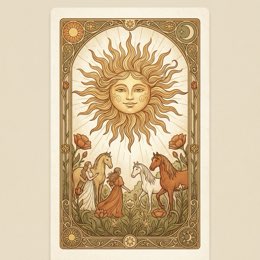
The Sun in a reading signals genuine progress and unfiltered transparency; there's no shadow to hide behind. The naked child rides forward under a glaring sun, waving a red banner: this is a card of real results, not vague promises. It's a reminder to celebrate what's actually working, not just what you hope will materialize.
But the Sun's blunt honesty can be a double-edged sword. If you're squinting in the light, something in your life may be overexposed; success drawing envy, optimism bordering on denial, or a relentless drive burning you out. This card doesn't sugarcoat: it asks you to confront the reality of your wins and how they land, for better or worse.
Symbols to notice
Use the imagery itself as part of the reading; posture, direction, and repeated objects usually carry the message.
Practical advice: Keep it simple and let the truth show.
Reading angles
General
Clarity, success, and plain truth are available.
Love
Warmth works best when it stays honest.
Career
Visible results can speak for themselves.
Money
Simple, solid choices pay off.
Major Arcana · The Sun in readings
Use it in love
Upright: In romance, The Sun is the green light: honest attraction, mutual joy, and no need to hide your feelings. If you're single, you're noticeably glowing; others see it, and chances are real. Couples find shared happiness in simple, everyday moments.
Reversed: In love, reversed Sun can mean showing off a relationship for approval or ignoring issues beneath the surface. Attraction may be all for show, or expectations set too high. It's time to check whether joy is genuine; or just for the audience.
Use it in career and money
Upright: Career gets a massive energy boost with The Sun. Projects succeed publicly, and your contributions don't go unnoticed. Take credit for your work, but don't rest too long; others will look to you for leadership now.
Reversed: Reversed, The Sun suggests overpromising or burnout at work. You may be chasing recognition without substance; or pushing yourself into exhaustion to maintain your streak. Slow down and focus on real achievements, not just applause.
Upright in context
When upright, The Sun strips away excuses and second-guesses. What you see is what you get; unearned doubts and lingering anxieties melt under its heat. You're in a position to claim your accomplishments without shame or apology.
Reversed in context
Reversed, The Sun warns against mistaking performative cheer for genuine happiness. Are you playing up your wins for the crowd, or refusing to admit when things need work? A hollow victory feels especially glaring under this card's scrutiny.
Journal prompt
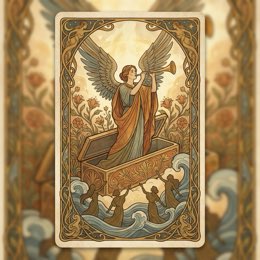
What becomes obvious when you stop overcomplicating it?
Major Arcana · reckoning
Core keywords
reckoningawakeningclarity
Reversed shadow
avoidanceregretstagnation
Upright cue
With Judgement upright, the message is clear: you're out of excuses, and the past is coming due.
Reversed cue
Judgement reversed means ducking responsibility or pretending the wake-up call isn't for you.
What the card is really saying
Judgement cuts through excuses and nostalgia. The naked figures rise to Gabriel's horn because the call can no longer be ignored. Your full story is on the table now, stripped of spin and sentimentality. There's no room to dodge consequences or dance around necessary decisions. What's done is done, and now it's time to face it.
This card is about waking up to reality and taking responsibility. In readings, Judgement pushes you to assess what's working, what isn't, and what must change if you want to move forward. The wake-up call might sting, but it can also clear the ground for closure and real change.
Symbols to notice
Use the imagery itself as part of the reading; posture, direction, and repeated objects usually carry the message.
Practical advice: Respond to the call and stop delaying.
Reading angles
General
A reckoning or wake-up call is here.
Love
Old choices need an honest review.
Career
This is a moment to answer for the past.
Money
Clean up the backlog and make the call.
Major Arcana · Judgement in readings
Use it in love
Upright: Judgement upright in love reads like a relationship audit; baggage comes up, confessions need to happen, and real commitment is on the table. If you're single, it's time to get brutally honest about your patterns and what you truly want.
Reversed: If Judgement is reversed in love, avoidance rules the day: tough conversations go unspoken, and you keep spinning in old cycles. Until you face these issues, progress is stalled and resentments accumulate.
Use it in career and money
Upright: In career, Judgement upright signals a major review; think performance evaluations or the repercussions of recent choices. If you've been putting in the work, this can bring well-earned recognition; if not, it's time to answer for dropped balls.
Reversed: You might be dodging accountability or missing out on promotions because you won't confront your mistakes. Judgement reversed in work contexts says you're stuck until you acknowledge what went wrong.
Upright in context
With Judgement upright, the message is clear: you're out of excuses, and the past is coming due. This card demands you assess your actions honestly, drop the self-deception, and prepare for the next chapter. There's relief in this kind of honesty; it frees you from old baggage that has held you back.
Reversed in context
Judgement reversed means ducking responsibility or pretending the wake-up call isn't for you. Maybe you're clinging to old mistakes or refusing to let go of a story that no longer serves. The result is staying stuck in the same old cycle and feeling worse every time it repeats.
Journal prompt
What decision can’t be postponed anymore?
Major Arcana · completion
Core keywords
completionintegrationachievement
Reversed shadow
unfinished businessstagnationloose ends
Upright cue
When upright, The World is a green light to wrap up projects and collect well-earned rewards.
Reversed cue
Reversed, The World makes it clear you've stalled before the actual end, either by your own avoidance or circumstances out of your control.
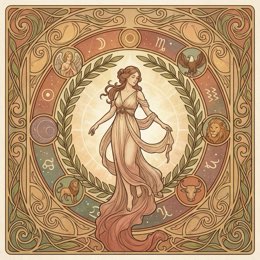
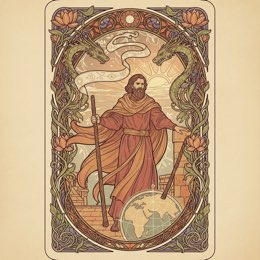
What the card is really saying
A crowned dancer hovers in an oval wreath, each limb gracefully balanced and looking directly out; this is a card for those who have actually reached the end. The World doesn't hand out trophies for participation; it marks the rare moment when effort, skill, and time click into final form.
This card's energy is decisive and unapologetic; whatever was in motion has now played out, and you have something real to show for it. If you're still asking what it all means, you're probably not there yet; The World is unmistakable when it lands in a reading.
Symbols to notice
Use the imagery itself as part of the reading; posture, direction, and repeated objects usually carry the message.
Practical advice: Finish cleanly and mark what was achieved.
Reading angles
General
A cycle is complete and ready to close.
Love
This phase wants integration, not more chasing.
Career
The work is ready to be wrapped up.
Money
Completion should come with a real account of results.
Major Arcana · The World in readings
Use it in love
Upright: The World upright in love readings suggests a relationship has reached a satisfying milestone; think commitment, moving in, or simply real mutual understanding. If single, it points to finally feeling whole on your own terms, rather than searching for validation.
Reversed: Reversed, The World in love signals the conversation that never happens or the ex that lingers in your mind; closure evades you, and it's holding things up. Until you finish the unfinished, new connections or deeper trust will run into roadblocks.
Use it in career and money
Upright: Expect recognition and well-deserved validation for your work; this is promotion territory or at least public acknowledgment. If you're waiting on a project to wrap up, trust that you're finally hitting the summit. Celebrate, but also start considering what's next.
Reversed: Tasks trail behind, or promised outcomes keep getting pushed back. Reversed, The World says you're either avoiding the last steps, or external factors prevent you from closing out. Finish what's on your desk before plotting your next career move.
Upright in context
When upright, The World is a green light to wrap up projects and collect well-earned rewards. This isn't luck or a fluke; if the card appears, look for areas where your persistence has paid off, even if the victory feels overdue.
Reversed in context
Reversed, The World makes it clear you've stalled before the actual end, either by your own avoidance or circumstances out of your control. The last task, reveal, or goodbye hasn't happened yet, leaving the door half-open and satisfaction out of reach.
Journal prompt
What can be closed so the next cycle can begin?
Arcana Muse library
Suit of Wands
Drive, ambition, energy, creative momentum, and the way desire moves into action.
Suit of Wands · new beginnings
Core keywords
new beginningscreative sparkinspiration
Upright cue
When the Ace of Wands appears upright, something is activating.
Reversed cue
Reversed, the Ace of Wands doesn't mean the fire is gone; it means something is blocking it.
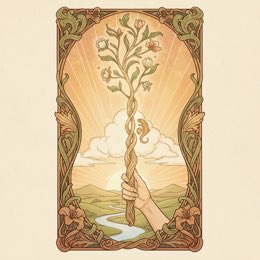
What the card is really saying
The Ace of Wands is fire in its purest form. No history, no baggage; just raw creative potential waiting to be channeled. Every ace in tarot represents a gift from the universe, and this one hands you a torch. The question isn't whether the spark is real. It is. The question is whether you'll pick it up and run with it.
Wands are the suit of fire: ambition, passion, creativity, and the will to act. The Ace is the seed of all that. It shows up when something genuinely new is possible; a project, a venture, a chapter of life that hasn't been written yet. This card doesn't promise success. It promises a real opportunity to begin.
Symbols to notice
Use the imagery itself as part of the reading; posture, direction, and repeated objects usually carry the message.
Practical advice: Start with one concrete move.
Reading angles
General
A fresh opening is here; move with initiative and momentum.
Love
A new connection can begin; keep the spark honest and active.
Career
The first move sets the tone; lead, pitch, or launch.
Money
A practical opportunity is on the table; back action that can grow.
Suit of Wands · Ace of Wands in readings
Use it in love
Upright: A passionate new connection, renewed desire in an existing relationship, or the start of something with real chemistry and spark. This isn't a slow burn; it's immediate, magnetic attraction. If you're single, someone may appear who genuinely excites you. If you're partnered, this is a good time to do something boldly romantic.
Reversed: Excitement that doesn't quite ignite, a flirtation that fizzles before it starts, or a relationship where one person is far more invested than the other. The desire might be real but the timing, circumstances, or compatibility isn't aligning. Don't mistake intensity of feeling for a viable connection.
Use it in career and money
Upright: A career opportunity you should take seriously; a new role, a business idea, a project that could define the next phase of your professional life. Financially, this can signal a good time to invest in yourself: training, tools, a calculated bet on your own potential. Check out what tarot can reveal about job changes if this resonates.
Reversed: An idea that looks good on the surface but doesn't have legs yet. Be wary of jumping at something exciting without doing the groundwork. A business venture may need more planning before launch. Financially, this warns against impulsive spending driven by enthusiasm rather than strategy.
Upright in context
When the Ace of Wands appears upright, something is activating. You might have just landed on a new idea, felt a burst of motivation after a long stall, or sensed that a creative direction is calling you. This isn't wishful thinking; there's genuine energy here, the kind that makes you want to act now instead of planning forever.
Reversed in context
Reversed, the Ace of Wands doesn't mean the fire is gone; it means something is blocking it. Maybe you can feel the inspiration but can't translate it into action. Maybe you've started three things and finished none. The creative force is real; the channel for it isn't clear yet.
Journal prompt
What first move would make this real?
Suit of Wands · bold planning
Core keywords
bold planningfuture visionexpansion
Upright cue
The Two of Wands upright says your original idea was good, and now it's time to take it seriously.
Reversed cue
Reversed, the Two of Wands points to a specific kind of stall: you can see what you want, but you won't commit to going after it.
What the card is really saying
The Two of Wands is the moment after the spark catches. You've had the idea, you've felt the pull; and now you're standing somewhere elevated, looking out at what's possible. The traditional image shows a figure holding the world literally in their hands. That's not arrogance. That's the feeling of real potential when you've been honest about your ambition.
This is a planning card, not a doing card. The fire of Wands is here, but it's being channeled into vision rather than action. You're mapping the territory before you set foot in it. That's not hesitation; that's intelligence. The Two asks you to think bigger than your current circumstances suggest you should.
Symbols to notice
Use the imagery itself as part of the reading; posture, direction, and repeated objects usually carry the message.
Practical advice: Name the priority before splitting your energy.
Reading angles
General
A choice or balance point is here; move with initiative and momentum.
Love
Two paths need honesty; keep the spark honest and active.
Career
Priorities need to be set; lead, pitch, or launch.
Money
The numbers need balancing; back action that can grow.
Suit of Wands · Two of Wands in readings
Use it in love
Upright: Looking forward together; making plans with a partner, talking about where this relationship could go, or deciding to take a connection to the next level. If you're single, this card suggests you have a clear picture of what you want; now it's time to go actively find it rather than wait for it to arrive.
Reversed: Commitment hesitation; one person may be holding back from declaring where things stand. There's vision of a future together but reluctance to take the steps that would make it real. Address this directly rather than letting the ambiguity fester.
Use it in career and money
Upright: A strong signal to expand. A business idea deserves a real business plan. A career ambition deserves an actual strategy, not just a wish. Financially, this is a good time to think about where you want to be in three to five years and reverse-engineer what that requires of you now.
Reversed: Plans that look bold on paper but lack commitment behind them. You might be spending more time planning than executing, or letting a fear of failure keep you from making the moves you've already mapped out. The strategy is ready. What's missing is the decision to act on it.
Upright in context
The Two of Wands upright says your original idea was good, and now it's time to take it seriously. This means moving beyond the daydream stage into actual plans: timelines, resources, decisions about direction. You might be weighing two paths; staying where you are versus making a move into something larger and less certain. This card leans toward the larger option.
Reversed in context
Reversed, the Two of Wands points to a specific kind of stall: you can see what you want, but you won't commit to going after it. Maybe the risk feels too real now that the planning is done. Maybe you're cycling through "what ifs" instead of making a call. This card reversed isn't about lacking vision; it's about refusing to bet on your own vision.
Journal prompt
What choice would make the balance clearer?
Suit of Wands · expansion
Core keywords
expansionforesightprogress
Upright cue
The Three of Wands upright is a genuinely encouraging card.
Reversed cue
Reversed, the Three of Wands signals that what you launched isn't coming back the way you expected.
What the card is really saying
The Three of Wands is what happens after you make the bold decision from the Two of Wands. You've committed, you've launched, and now your plans are out in the world doing what plans do; encountering reality. The figure on this card stands on high ground watching ships on the horizon. This isn't passive waiting. It's strategic watching.
Threes in tarot represent the first fruits of action, the early evidence that something is working. In the suit of Wands, this means your fire is burning productively. You're not stuck in the planning stage anymore. You're in the early momentum phase; far enough along to see real progress, still far enough from the finish line to need patience.
Symbols to notice
Use the imagery itself as part of the reading; posture, direction, and repeated objects usually carry the message.
Practical advice: Bring in help and define roles.
Reading angles
General
Momentum grows through collaboration; move with initiative and momentum.
Love
Shared effort strengthens the bond; keep the spark honest and active.
Career
Partnership makes progress easier; lead, pitch, or launch.
Money
Coordination can improve results; back action that can grow.
Suit of Wands · Three of Wands in readings
Use it in love
Upright: A relationship that's growing and has genuine legs. You've passed the initial spark stage and things are developing into something with actual depth and future potential. For singles, this card suggests you're in the right mindset to find something real; your vision of what you want is clear and realistic.
Reversed: A connection that isn't developing the way you'd hoped. Progress feels stalled. Long-distance relationships may face particular strain here. Don't assume the problem is the relationship itself; examine whether the distance is logistical or emotional.
Use it in career and money
Upright: Strong career momentum. Projects are gaining traction. If you've been building toward something, this card says you're on the right track and early results should encourage you to stay the course. Financially, look beyond your current market; there may be income streams or opportunities in places you haven't considered yet.
Reversed: A business venture or career plan running into unexpected friction. The core idea may be sound but the execution needs adjustment. Avoid the trap of doubling down on a flawed approach just because you've already committed to it. Adapt early rather than late.
Upright in context
The Three of Wands upright is a genuinely encouraging card. Things you set in motion are developing. Plans you made are bearing first results. This card often appears when someone has taken a real risk; moved to a new city, launched a business, committed to a creative project; and the early signs are positive. The horizon is opening up rather than closing down.
Reversed in context
Reversed, the Three of Wands signals that what you launched isn't coming back the way you expected. The ships are delayed, or what returns isn't quite what you sent out. This could mean concrete obstacles; a project hitting real-world friction, a plan needing significant revision, timing working against you. It's not necessarily failure; it's a gap between expectation and reality that needs to be addressed.
Journal prompt
What needs to join forces so progress can build?
Suit of Wands · celebration
Core keywords
celebrationmilestonecommunity
Upright cue
When the Four of Wands appears upright, something deserves to be celebrated and you should actually celebrate it.
Reversed cue
Reversed, the Four of Wands doesn't mean the celebration is cancelled; it means it's incomplete or complicated.
What the card is really saying
The Four of Wands is one of the warmest cards in the deck. It represents a real moment of completion, not the end of the journey, but a significant checkpoint worth honoring. The traditional image shows a garland-draped canopy with people celebrating beneath it: a harvest festival, a wedding, a return home. The fire of Wands here is communal rather than solitary.
Fours in tarot represent structure and stability. In the Wands suit, that stability takes the form of earned rest, celebration with others, and the joy of belonging to something. This card doesn't mean ambition stops; it means you've earned a moment to stand in what you've built and actually feel it. That's rarer than it sounds.
Symbols to notice
Use the imagery itself as part of the reading; posture, direction, and repeated objects usually carry the message.
Practical advice: Stabilize before you push further.
Reading angles
General
Stability matters more than speed; move with initiative and momentum.
Love
Security and boundaries matter; keep the spark honest and active.
Career
Pause and lock in the structure; lead, pitch, or launch.
Money
Hold steady and avoid drift; back action that can grow.
Suit of Wands · Four of Wands in readings
Use it in love
Upright: A major relationship milestone; an engagement, a move-in together, a commitment ceremony, or simply the moment when a relationship steps into something more solid and officially shared. This card is genuinely joyful in love contexts and suggests a happy, stable partnership built on mutual warmth.
Reversed: A relationship event that didn't land the way it was supposed to; a proposal that created more anxiety than joy, a cohabitation that's revealing incompatibilities, or a celebration derailed by unresolved issues. The love may be real; the timing or circumstances need attention.
Use it in career and money
Upright: Recognition for your work. A promotion, a successful launch, a project that hits its target and gets acknowledged. Financially, this is a stable moment, not explosive growth, but solid ground. You can stand on what you've built. Take a moment to appreciate that before pushing immediately toward the next goal.
Reversed: A career win that comes with complications; a promotion that creates new tensions, a successful project that doesn't get the recognition it deserved, or financial stability that feels precarious underneath. Address the instability directly rather than pretending the celebration covers it.
Upright in context
When the Four of Wands appears upright, something deserves to be celebrated and you should actually celebrate it. Tarot readers often rush past this card to find the drama, but the Four of Wands is asking you to pause. You've done real work. Something has been accomplished; a project completed, a goal reached, a commitment made real. Honor that before you move on to the next thing.
Reversed in context
Reversed, the Four of Wands doesn't mean the celebration is cancelled; it means it's incomplete or complicated. Maybe a milestone happened but felt hollow. Maybe you achieved something significant but couldn't share it with the people you wanted to. Or the event itself was undermined by tension, conflict, or circumstances that prevented full enjoyment.
Journal prompt
What needs to settle before you push ahead?
Suit of Wands · competition
Core keywords
competitionconflictchaos
Upright cue
The Five of Wands upright says you're in a competitive environment and that's not necessarily bad.
Reversed cue
Reversed, the Five of Wands can mean the conflict is finally dying down; the noise is settling, people are exhausted from the fighting, and a more cooperative approach is starting to emerge.
What the card is really saying
The Five of Wands depicts five figures each wielding a staff, seemingly fighting; but look closely and it's not clear anyone is actually winning or losing. This card captures the energy of competition and conflict without a definitive outcome. It's the chaos of a crowded field where everyone has an opinion, a plan, or an ego invested in being right.
Fives in tarot signal disruption and challenge. In Wands, this takes the form of external friction; competing ambitions, rivalries, clashing ideas, or an environment where everyone is fighting for the same limited ground. This isn't the quiet internal struggle of the Swords suit. This is loud, messy, and very much in your face. The question is whether this friction is productive or just draining.
Symbols to notice
Use the imagery itself as part of the reading; posture, direction, and repeated objects usually carry the message.
Practical advice: Address the pressure instead of working around it.
Reading angles
General
Pressure is exposing the weak spot; move with initiative and momentum.
Love
Tension needs a direct answer; keep the spark honest and active.
Career
Conflict is part of the brief; lead, pitch, or launch.
Money
Strain needs attention now; back action that can grow.
Suit of Wands · Five of Wands in readings
Use it in love
Upright: Arguments, power struggles, or competing needs making communication difficult. This doesn't necessarily mean a relationship is doomed; it may mean you're in a phase where both people are asserting themselves and the dynamic needs to find a new equilibrium. Healthy couples fight; the difference is whether you're fighting toward understanding or just fighting.
Reversed: A conflict that's been stuffed down rather than resolved. There may be surface-level calm in the relationship while real resentments build underneath. Get the actual issue out in the open, or it will emerge at the worst possible time.
Use it in career and money
Upright: A highly competitive work environment; multiple candidates for the same role, competing proposals, a market with too many players. Stay focused on what distinguishes your work rather than getting caught up in who's doing what around you. Financially, there may be multiple demands on limited resources right now.
Reversed: Workplace conflict that's gone quiet but not resolved. Office tensions simmering. Or alternatively; you're finally seeing a chaotic competitive situation stabilize. If it's the latter, use the relative calm to consolidate your position rather than continuing to fight battles that are winding down.
Upright in context
The Five of Wands upright says you're in a competitive environment and that's not necessarily bad. Competition can sharpen you. Debate can clarify ideas. Friction can expose weaknesses in your approach before they become real problems. If you're launching something into a crowded market, this card acknowledges the challenge while also suggesting you belong in the ring.
Reversed in context
Reversed, the Five of Wands can mean the conflict is finally dying down; the noise is settling, people are exhausted from the fighting, and a more cooperative approach is starting to emerge. If you've been in a sustained period of competition or conflict, this position can signal that the worst is behind you.
Journal prompt
What pressure is asking for a direct answer?
Suit of Wands · victory
Core keywords
victorypublic recognitionsuccess
Upright cue
The Six of Wands upright is a strong positive signal.
Reversed cue
Reversed, the Six of Wands flags a specific set of problems around recognition and ego.
What the card is really saying
The Six of Wands is the victory card of the Wands suit. After the chaos and competition of the Five, someone has emerged ahead. The traditional image shows a figure on horseback wearing a laurel wreath and being cheered by a crowd. This isn't quiet, private satisfaction; it's public acknowledgment of real achievement.
The fire of Wands at its best is here: confidence earned through effort, recognition given freely by others, the feeling of momentum and mastery. This card doesn't show someone who got lucky. It shows someone who committed to their fire, navigated the friction, and came out ahead. That story matters; it's the difference between a confidence that holds and one that collapses under pressure.
Symbols to notice
Use the imagery itself as part of the reading; posture, direction, and repeated objects usually carry the message.
Practical advice: Accept support or give it cleanly.
Reading angles
General
Support and exchange are important; move with initiative and momentum.
Love
Give and receive more evenly; keep the spark honest and active.
Career
Recognition or help can move things; lead, pitch, or launch.
Money
Fair exchange changes the picture; back action that can grow.
Suit of Wands · Six of Wands in readings
Use it in love
Upright: A relationship that feels genuinely good and is recognized by both people. You might be entering a phase of real confidence as a couple; finally feeling secure, finally showing your relationship to the world without reservation. Individually, this card suggests you're at your most attractive and magnetic right now.
Reversed: A relationship where one person needs more recognition and validation than the other can provide. Or someone whose confidence has tipped into self-centeredness, making them difficult to actually be with even when they're exciting. Needing applause in a relationship is a different thing from deserving care.
Use it in career and money
Upright: A career high point; a promotion, a public win, an award, being specifically named for your contribution. Financially, the effort you've put in is starting to pay off in concrete terms. This is the kind of momentum you want to ride into your next big move while the confidence is real and the reputation is warm.
Reversed: Feeling overlooked despite strong work. Someone else taking credit for your output. Or the opposite; overestimating your own contribution and alienating the people whose support you actually need. If it's the former, document your work; if it's the latter, recalibrate before you burn bridges.
Upright in context
The Six of Wands upright is a strong positive signal. Something you've been working toward is succeeding, and people around you are noticing. A project gets approved, a pitch lands, a creative effort gets real traction. If you've been questioning whether your work is good enough, this card is a fairly direct answer: yes, it is, and others can see it too.
Reversed in context
Reversed, the Six of Wands flags a specific set of problems around recognition and ego. One version is victory that's arriving late or quietly; you've succeeded but the external acknowledgment hasn't come, or it came in a form that felt inadequate. Another version is imposter syndrome: you've actually won but you can't let yourself believe it, always expecting the recognition to be taken back.
Journal prompt
Where would a fair exchange make the biggest difference?
Suit of Wands · defensiveness
Core keywords
defensivenessstanding your groundperseverance
Upright cue
The Seven of Wands upright says you're under pressure from multiple directions and the right response is to stand firm.
Reversed cue
Reversed, the Seven of Wands has two main expressions.
What the card is really saying
The Seven of Wands shows a figure on a hilltop fending off six staffs coming at them from below. The asymmetry is deliberate: one against many, but from the higher position. This card is the natural follow-up to the Six of Wands victory; when you've achieved something and risen above the crowd, others will challenge you for that position. Success creates competition.
This isn't about being paranoid or seeing enemies everywhere. It's the realistic acknowledgment that visible success attracts scrutiny, challenge, and people who want what you have. The question the Seven of Wands asks isn't whether you'll be challenged; you will; but whether you believe your position is worth defending. If the answer is yes, hold the ground. If the answer is uncertain, that's worth examining.
Symbols to notice
Use the imagery itself as part of the reading; posture, direction, and repeated objects usually carry the message.
Practical advice: Hold your ground, but stay evidence-based.
Reading angles
General
Stand firm, but stay alert; move with initiative and momentum.
Love
Defend the relationship carefully; keep the spark honest and active.
Career
Protect your position with evidence; lead, pitch, or launch.
Money
Patience beats a rushed decision; back action that can grow.
Suit of Wands · Seven of Wands in readings
Use it in love
Upright: A relationship under external pressure; family disapproval, social judgment, or competing demands on one person's time and energy. This card asks whether you're willing to actively protect and defend what you have together. If you believe in the relationship, show up for it even when it's inconvenient.
Reversed: Either abandoning the relationship too easily when things get difficult, or being so defensive within the relationship that you can't actually connect. A pattern of treating a partner's honest feedback as an attack rather than communication.
Use it in career and money
Upright: Professional scrutiny, a challenging review, competition from below, or having your ideas challenged publicly. This isn't pleasant, but it's also evidence that you're operating at a level where your work matters enough to attract criticism. Defend your position with specifics and evidence, not just conviction. See this piece on career readings for more on navigating professional pressure.
Reversed: Backing down from a salary negotiation, abandoning a good idea because someone pushed back, or alternatively; exhausting everyone around you with constant defensiveness about your methods. Know which version you're living.
Upright in context
The Seven of Wands upright says you're under pressure from multiple directions and the right response is to stand firm. Not to escalate, not to retreat; to hold your position with clarity and conviction. You've earned what you have. Someone or several someones are questioning it, challenging it, or actively trying to undermine it. Your job is to not crumble under the pressure.
Reversed in context
Reversed, the Seven of Wands has two main expressions. The first is capitulation: you're caving to pressure you shouldn't be caving to, abandoning a position that was actually sound because the opposition felt overwhelming. Someone criticized your work and you gutted it. Someone pushed back on your boundary and you dissolved it. The challenge was real, but the response was disproportionate.
Journal prompt
What are you protecting when the pressure rises?
Suit of Wands · speed
Core keywords
speedmomentumswift action
Upright cue
The Eight of Wands upright tells you things are moving; possibly faster than you expected.
Reversed cue
Reversed, the Eight of Wands signals a frustrating halt to what should be moving.
What the card is really saying
The Eight of Wands is the fastest card in the deck. Eight staffs arc through clear air, all aimed in the same direction; no obstacles, no people, just pure kinetic energy in motion. This card doesn't show preparation or planning. It shows things that are already in flight, already committed, already on their way to a destination.
This is Wands fire at its most kinetic: pure movement, velocity, things happening now. After the defensive stance of the Seven, the Eight clears the field and accelerates. When this card appears, the message is consistent: move fast, act on what's in motion, don't second-guess what's already launched. The window for deliberation has closed; the window for decisive action is wide open.
Symbols to notice
Use the imagery itself as part of the reading; posture, direction, and repeated objects usually carry the message.
Practical advice: Keep moving and do not lose pace.
Reading angles
General
Things are picking up; move with initiative and momentum.
Love
Things move faster than expected; keep the spark honest and active.
Career
Momentum rewards quick follow-through; lead, pitch, or launch.
Money
Progress depends on staying organized; back action that can grow.
Suit of Wands · Eight of Wands in readings
Use it in love
Upright: A relationship moving quickly; intense, fast-developing, possibly overwhelming in the best way. Text-message flirtations blossoming fast, a connection that's escalating in intensity. Or existing partnerships entering a new, exciting phase. Things are happening; don't overthink what's flowing naturally.
Reversed: Communication problems that are creating distance; messages going unanswered, mixed signals, things getting lost in translation. Or a relationship moving so fast it's becoming destabilizing. Speed can feel exciting; it can also mean things haven't been properly built.
Use it in career and money
Upright: Fast-moving professional developments: a quick hiring process, a project ramping up faster than planned, news about an opportunity arriving sooner than expected. Financially, things are moving in a positive direction with genuine velocity. Act on what's in front of you rather than waiting for more certainty.
Reversed: A project hitting unexpected delays after a fast start. A deal stalling out. Travel disruptions affecting work. Or impulsive financial decisions made in a rush that need revisiting. The speed was real; the foundation may not have been. Identify specifically what the bottleneck is rather than pushing harder in a blocked direction.
Upright in context
The Eight of Wands upright tells you things are moving; possibly faster than you expected. A project that was stalled suddenly breaks open. Communication that was slow starts flowing. A decision you've been weighing becomes urgent because circumstances are shifting beneath you. The card's energy is exhilarating but demands responsiveness.
Reversed in context
Reversed, the Eight of Wands signals a frustrating halt to what should be moving. The energy is there, the intention is there, but something is blocking the flow; technical delays, communication breakdowns, logistics falling apart, bureaucratic friction stopping fast-moving plans cold. This is the feeling of being ready to sprint and finding the gate locked.
Journal prompt
What should move now so momentum does not stall?
Suit of Wands · resilience
Core keywords
resiliencepersistencelast stand
Upright cue
The Nine of Wands upright is honest about being tired.
Reversed cue
Reversed, the Nine of Wands is most painful when it shows someone abandoning a worthy goal just before reaching it.
What the card is really saying
The Nine of Wands shows a weary figure leaning on a staff, bandaged from previous battles, with eight more staffs planted in a row behind them like a defensive barrier. They're not done; but they've been through it. This card captures a very specific human experience: the moment when you've given most of what you have, you can see the end is near, and everything in you wants to stop.
This is Wands fire at its most tested. The energy is still there, but it's defensive now rather than expansive. The suit that started with pure creative spark at the Ace has been through competition, conflict, victory, and defeat. The Nine knows what fire costs. Its wisdom is hard-won rather than enthusiastic.
Symbols to notice
Use the imagery itself as part of the reading; posture, direction, and repeated objects usually carry the message.
Practical advice: Finish strong and do not quit early.
Reading angles
General
You are near the finish line; move with initiative and momentum.
Love
Endurance is being tested; keep the spark honest and active.
Career
The last stretch asks for focus; lead, pitch, or launch.
Money
Results are close, but not finished; back action that can grow.
Suit of Wands · Nine of Wands in readings
Use it in love
Upright: A relationship that has been through difficulty and is still standing. The weariness is mutual, but so is the commitment. This card asks whether both people still want what they originally started building, not whether they have the energy right now, but whether it's worth finding the energy. Usually the answer is yes.
Reversed: Hypervigilance in relationships born from old wounds; bringing past trauma into a present situation that doesn't warrant it, pushing people away before they can hurt you, or staying in protective mode so long that you've forgotten what connection actually feels like. Past pain is real; it shouldn't permanently govern the present.
Use it in career and money
Upright: A long project is near completion; the end is close even if it doesn't feel that way. Professional resilience is the core theme; staying in the ring through difficult circumstances. Don't quit a job application, a business venture, or a creative project when you're this close. Check out this piece on career tarot if the exhaustion is about whether a change is actually warranted.
Reversed: Burning out before the finish line. Or alternatively, being so risk-averse from previous failures that you're not willing to make the moves your situation actually requires. Financial caution is appropriate after setbacks; paralysis is not.
Upright in context
The Nine of Wands upright is honest about being tired. You've been through a lot to get where you are, and the road has taken a toll. But the card's message is equally honest: you're closer than you think. The finish line is one more push away. This isn't cheerleading; it's a genuine assessment that the effort you've made is about to pay off if you can summon one more round of it.
Reversed in context
Reversed, the Nine of Wands is most painful when it shows someone abandoning a worthy goal just before reaching it. The exhaustion is real, but the distance remaining is shorter than it feels. Quitting at nine when completion is ten is a specific kind of loss; made worse by the fact that you'll likely always wonder what would have happened.
Journal prompt
What would help you finish without burning out?
Suit of Wands · overwork
Core keywords
overworkburdensstress
Reversed shadow
releasedelegationcollapse
Upright cue
Upright, the Ten of Wands means you're stuck in a cycle of obligation, chained to your own sense of duty or fear of disappointing others.
Reversed cue
Reversed, the Ten of Wands offers relief; if you're willing to actually offload.
What the card is really saying
The Ten of Wands doesn't mince words; this is the classic card of biting off more than you can chew. You're weighed down by obligations, and what started as ambition now feels like a grind, each wand another item on your endless to-do list. The finish line is there, but dragging yourself toward it with all that baggage means you're too tired to celebrate when you finally arrive.
This card reminds you that doing everything yourself isn't noble; it's unsustainable. It's a moment to acknowledge where you're stuck carrying unnecessary weight and to question why you keep saying yes. The Ten of Wands points to a breaking point: put down what you can, or risk letting everything fall at once.
Symbols to notice
Use the imagery itself as part of the reading; posture, direction, and repeated objects usually carry the message.
Practical advice: Lighten the load and close the loop.
Reading angles
General
The cycle is reaching its limit; move with initiative and momentum.
Love
Something needs to be completed; keep the spark honest and active.
Career
The load is at capacity; lead, pitch, or launch.
Money
A chapter is ready to close; back action that can grow.
Suit of Wands · Ten of Wands in readings
Use it in love
Upright: In relationships, the Ten of Wands upright suggests you're doing all the emotional heavy lifting or carrying unresolved issues solo. It's time to demand mutual effort or admit that one person can't fix everything.
Reversed: Reversed, this is either a break from relationship burdens or someone flat-out avoiding hard conversations. Honesty about who's carrying what is overdue.
Use it in career and money
Upright: At work, you're overloaded; taking on too many projects, covering for others, or unable to say no. Eventually, quality drops and resentment rises; something has to give.
Reversed: Reversed, the card says you're finally letting go of a toxic workload, or, less nobly, passing the buck and leaving colleagues in the lurch. Either way, balance is overdue.
Upright in context
Upright, the Ten of Wands means you're stuck in a cycle of obligation, chained to your own sense of duty or fear of disappointing others. The image says it all; one person, all the wands, no one to help. You might get to the goal, but you'll be exhausted and frustrated instead of triumphant.
Reversed in context
Reversed, the Ten of Wands offers relief; if you're willing to actually offload. It can mean you're finally dropping obligations that were never yours to carry, or that you're learning how to delegate and trust others to pull their weight.
Journal prompt
What can be carried less so the burden eases?
Suit of Wands · enthusiasm
Core keywords
enthusiasmadventurecuriosity
Reversed shadow
impulsivenesslack of directiondelayed plans
Upright cue
In the upright position, the Page of Wands is restless and ready; a signal that it's time to act on an idea that excites you, even if the odds are untested.
Reversed cue
Reversed, the Page of Wands ditches projects halfway or jumps in with no follow-through, creating a trail of abandoned hobbies and fizzled plans.
What the card is really saying
A young figure stands in desert garb, staff gripped with eager hands, eyes fixed on distant possibilities. The Page of Wands doesn't wait for instructions or reassurance. This card is the first strike of the match: creative energy, new ventures, and a willingness to see what happens when you try. Don't expect guarantees or a roadmap. Curiosity comes first. Results can catch up later.
Still, the Page's spark can sputter if it has nowhere to go. Sometimes this is the card of chasing novelty and running out of steam before anything real happens. When the Page of Wands shows up, ask yourself what actually interests you. Then make sure you're acting on that interest rather than just feeding your restlessness.
Symbols to notice
Use the imagery itself as part of the reading; posture, direction, and repeated objects usually carry the message.
Practical advice: Stay curious and learn by doing.
Reading angles
General
A message or lesson is arriving; move with initiative and momentum.
Love
Curiosity comes before commitment; keep the spark honest and active.
Career
A learner's mindset helps; lead, pitch, or launch.
Money
Learn the basics before scaling; back action that can grow.
Suit of Wands · Page of Wands in readings
Use it in love
Upright: In love, the Page of Wands brings flirtation, spontaneity, and the kind of chemistry that makes things exciting again. New connections heat up quickly, or existing ones get a dose of playful adventure.
Reversed: Love-wise reversed, this Page is unreliable: big promises, little follow-through, and a tendency to get distracted at the first sign of real commitment or work. Don't take flashy interest at face value.
Use it in career and money
Upright: At work, this is a push to pitch your wild idea, volunteer for that new project, or try the untested route. You won't have all the experience, but quick action and open-mindedness set things in motion.
Reversed: Reversed in career, the Page of Wands is the unfinished business on your desk: missed deadlines, scattered priorities, and moments you talked a big game and delivered little. Time to pick one direction and finish it.
Upright in context
In the upright position, the Page of Wands is restless and ready. It's time to act on an idea that excites you, even if the odds are untested. This isn't about expertise. It's about the guts to try, experiment, and learn by doing.
Reversed in context
Reversed, the Page of Wands ditches projects halfway or jumps in with no follow-through, creating a trail of abandoned hobbies and fizzled plans. There's plenty of talk, but little gets finished; enthusiasm gets scattered or undermined by self-doubt.
Journal prompt
What are you ready to learn or test?
Suit of Wands · action
Core keywords
actionadventureconfidence
Reversed shadow
recklessnessdelayarrogance
Upright cue
You're in the mood to make things happen, and you're not inclined to ask for anyone's blessing.
Reversed cue
The reversed Knight of Wands crashes headlong into his own impatience: false starts, misfires, or promising way more than you can deliver.
What the card is really saying
The Knight of Wands charges ahead with almost reckless enthusiasm. He wants action now and isn't interested in waiting for permission; the figure, clad in bright armor and brandishing a wand ablaze, signals bold moves and dynamic energy. When this card shows up, it's time to push boundaries and tackle projects with a hands-on, fearless attitude. This isn't a contemplative mood; it's a mandate for momentum, even if the plan isn't perfect.
But the Knight can be restless to a fault. He's prone to cutting corners and can abandon commitments for the next spark of excitement. You may leap before you look; and if you're not careful, leave a trail of unfinished business. In short: it's time to do, but don't con yourself into thinking you're invincible.
Symbols to notice
Use the imagery itself as part of the reading; posture, direction, and repeated objects usually carry the message.
Practical advice: Act quickly, but don't outrun your plan.
Reading angles
General
The urge to move is strong; move with initiative and momentum.
Love
Pursuit and momentum shape this; keep the spark honest and active.
Career
Fast action is part of the story; lead, pitch, or launch.
Money
Acting quickly may open a door; back action that can grow.
Suit of Wands · Knight of Wands in readings
Use it in love
Upright: Your love life is anything but stagnant; expect whirlwind romance, passionate flirtation, or a partner who brings excitement but possibly inconsistency. Now's the time to embrace bold gestures, but don't confuse fireworks with commitment.
Reversed: Romantic plans may go sideways as the thrill wears off, leading to ghosting, broken promises, or heated arguments. Beware impulsive choices and partners who are more talk than action.
Use it in career and money
Upright: You're ready to launch something new or take a big professional risk; job changes, entrepreneurial moves, or leading a project. The energy's right for bold pitches, but don't let impatience undermine your results.
Reversed: Delays, rash decisions, and half-baked plans can haunt your work life now. If you're leaping from job to job or project to project, it's time to steady your course and avoid self-sabotage.
Upright in context
You're in the mood to make things happen, and you're not inclined to ask for anyone's blessing. This is the card that throws caution aside in favor of real-life experience. Expect rapid momentum, new projects, travel, or even a literal move; anything that stokes your creative or competitive fire.
Reversed in context
The reversed Knight of Wands crashes headlong into his own impatience: false starts, misfires, or promising way more than you can deliver. The drive for excitement turns into scattered energy; plans derail thanks to impulsivity or a lack of follow-through. Be wary of arrogance; the kind that can make you miss crucial details.
Journal prompt
What next move would keep this moving?
Suit of Wands · confidence
Core keywords
confidencedeterminationcharisma
Reversed shadow
jealousyinsecuritymanipulation
Upright cue
Expect a boost of confidence, resourcefulness, and clear vision.
Reversed cue
The Queen of Wands reversed is all smoke, no fire; confidence turns brittle and controlling, with snippy comments or stubborn silence replacing direct action.
What the card is really saying
This Queen knows her worth and makes sure others know it too. She's not afraid to take charge, push forward, and put her stamp on whatever she touches. The sunflower in her hand signals focus and vibrancy, while the cat implies she doesn't miss a trick; nothing escapes her attention, and she isn't afraid of a little intrigue.
Her energy demands action and honesty from everyone around her. Ignore her confidence at your peril; she will call out nonsense and expects that you do the same. This card suggests you don't just sit back and hope for the best; you make things happen, and you do it with unapologetic flair.
Symbols to notice
Use the imagery itself as part of the reading; posture, direction, and repeated objects usually carry the message.
Practical advice: Lead with competence and calm.
Reading angles
General
Steady maturity is the advantage; move with initiative and momentum.
Love
Care and composure carry weight; keep the spark honest and active.
Career
Good judgment beats haste; lead, pitch, or launch.
Money
Practical stewardship keeps things stable; back action that can grow.
Suit of Wands · Queen of Wands in readings
Use it in love
Upright: You attract attention and admirers when this Queen shows up; be honest about what you want, and don't be afraid to set clear boundaries. If partnered, expect bold conversations or passionate energy. This card favors decisive, direct communication.
Reversed: Drama and jealousy come to the forefront. There's a tendency for manipulation or resentment, so check your motives (and your partner's) before things escalate. Address insecurity head-on rather than letting it fester.
Use it in career and money
Upright: Take the lead and show what you can do; this isn't the time for shrinking back. Your energy inspires others, but only if you step fully into the role. Pitch that idea, run the meeting, start the project; own the room.
Reversed: A controlling attitude or fear of being outshone can backfire. Watch for undermining colleagues or micromanaging out of anxiety. Step back, share credit, and try to collaborate if you want real progress.
Upright in context
Expect a boost of confidence, resourcefulness, and clear vision. The Queen of Wands doesn't wait for permission, and neither should you; trust your instincts and make bold moves. The message is clear: show up, speak up, and own your power.
Reversed in context
The Queen of Wands reversed is all smoke, no fire; confidence turns brittle and controlling, with snippy comments or stubborn silence replacing direct action. Watch for jealousy and passive-aggressive moves, either from you or someone close by.
Journal prompt
How can you handle this with more steadiness?
Suit of Wands · leadership
Core keywords
leadershipvisiondetermination
Reversed shadow
impulsivenessarrogancedictatorship
Upright cue
You’re being called to step up and lead.
Reversed cue
The King of Wands reversed is a warning: your fire can scorch as easily as it can inspire.
What the card is really saying
With the King of Wands, you’re looking at someone who doesn’t just talk about goals, he charges forward and expects others to keep up. This card demands clear vision, decision, and the grit to back it up. His robe is decorated with salamanders and lions, symbols of fire and mastery, and he’s not afraid to step right into the heat himself.
But this king’s fire isn’t just for show. He expects loyalty, and he wants results. He is the person who starts the meeting, makes the call, and pushes the job over the line. Just don’t mistake his confidence for gentleness; if you’re not on board, he’ll steamroll right past.
Symbols to notice
Use the imagery itself as part of the reading; posture, direction, and repeated objects usually carry the message.
Practical advice: Set the direction, then enforce it cleanly.
Reading angles
General
Authority and long-range thinking matter; move with initiative and momentum.
Love
Responsibility and consistency matter; keep the spark honest and active.
Career
Decision-making needs a firm hand; lead, pitch, or launch.
Money
Long-term control is the priority; back action that can grow.
Suit of Wands · King of Wands in readings
Use it in love
Upright: In relationships, the King of Wands upright shows a partner who’s magnetic and assertive, sometimes to the point of being overwhelming. If you want passion and ambition, you’ll get it, but don’t expect much patience for indecision or passivity.
Reversed: Reversed, this card spells drama: controlling behavior, broken promises, or a lover who’s all flash and little substance. Watch for empty declarations or a tendency to throw their weight around.
Use it in career and money
Upright: This is prime entrepreneurial energy, a great time to pitch, lead, or rally a team. Take initiative and don’t be shy about setting a high bar; just make sure you can deliver what you sell.
Reversed: Here’s where ego gets in the way. Unchecked ambition, micromanagement, or flip-flopping on commitments could tank your credibility. Avoid domineering tactics and empty hype.
Upright in context
You’re being called to step up and lead. People will listen to you now, but only if you’re decisive and unapologetically committed. This is not a time for half-measures.
Reversed in context
The King of Wands reversed is a warning: your fire can scorch as easily as it can inspire. Pride and impatience risk burning bridges and alienating allies.
Journal prompt
What decision would create cleaner order here?
Arcana Muse library
Suit of Cups
Emotion, attachment, intuition, belonging, and the vulnerable truth under the surface.
Suit of Cups · new emotional beginning
Core keywords
new emotional beginningunconditional loveintuition opening
Upright cue
Upright, the Ace of Cups signals the arrival of emotional openness; yours or someone else's.
Reversed cue
Reversed, the Ace of Cups doesn't mean the emotional offer has disappeared.
What the card is really saying
The Ace of Cups is the seed of everything emotional. It represents the moment before a feeling becomes a story; the raw capacity to love, to feel, to receive. Water overflows from a cup held by a divine hand, and the message is simple: something is being offered. Whether you accept it is up to you.
Every Ace in the Minor Arcana carries this same quality; pure potential, unmixed with consequence or complication. The Ace of Cups is that potential applied to the inner life. It's the feeling you get on the first day of something that matters to you, before the doubts arrive. Cups rule water, emotion, intuition, relationship; and this card is their starting point. Everything that flows through the suit of Cups traces back here.
Symbols to notice
Use the imagery itself as part of the reading; posture, direction, and repeated objects usually carry the message.
Practical advice: Start with one concrete move.
Reading angles
General
A fresh opening is here; pay attention to feelings and trust.
Love
A new connection can begin; speak the feeling clearly.
Career
The first move sets the tone; watch the emotional climate.
Money
A practical opportunity is on the table; spend with care and awareness.
Suit of Cups · Ace of Cups in readings
Use it in love
Upright: New love, or a significant deepening of feeling in an existing relationship. If you're single, someone is likely coming who will genuinely move you, not just attract you. If you're partnered, something is softening or opening between you. Either way, the card asks you to be available to what's arriving.
Reversed: Emotional unavailability; your own, a partner's, or both. There's feeling underneath but it's locked away. If you're wondering why a connection isn't deepening despite real attraction, the reversal points to one or both of you keeping the guard up. It's worth asking what that guard is protecting. See also: how to use tarot for relationship readings.
Use it in career and money
Upright: A new project, role, or direction that genuinely lights something up in you, not just something that pays well or looks good on paper. The Ace of Cups in a career reading is marking the difference between work you perform and work that actually matters to you. The opportunity is real. Take it seriously.
Reversed: Going through the motions. You're doing the work but the inner engagement is absent; either because you've burned out or because this particular path was never really yours to begin with. The reversal nudges you toward naming that honestly rather than grinding forward on willpower alone.
Upright in context
Upright, the Ace of Cups signals the arrival of emotional openness; yours or someone else's. It's not a guarantee that love or connection will happen; it's a genuine opportunity for both. Think of it as an open door. The invitation is real. What you do with it determines what comes next.
Reversed in context
Reversed, the Ace of Cups doesn't mean the emotional offer has disappeared. It means something is blocking it. Usually that something is internal; old pain that makes opening up feel dangerous, a habit of suppression you learned long ago, or the plain fear that feeling this much will cost you something you're not ready to lose.
Journal prompt
What first move would make this real?
Suit of Cups · mutual attraction
Core keywords
mutual attractionpartnershipdeep connection
Upright cue
When the Two of Cups appears upright, something is clicking into place between you and another person.
Reversed cue
Reversed, the Two of Cups points to an imbalance that's hard to talk around.
What the card is really saying
The Two of Cups is about genuine meeting; two people, two energies, two emotional worlds making real contact. This isn't infatuation or projection. It's the moment when you look at someone and they look back with the same thing in their eyes. That's rarer than it sounds, and this card knows it.
In the Minor Arcana, twos represent duality finding its balance point. The Two of Cups sits at the exact midpoint between two cups raised toward each other; an image of offering and receiving that's equal in both directions. It applies to romantic partnership most obviously, but it can describe any relationship where the feeling is genuinely reciprocal: a friendship that goes deep, a creative collaboration that clicks, a professional bond built on real trust. What matters is the mutuality.
Symbols to notice
Use the imagery itself as part of the reading; posture, direction, and repeated objects usually carry the message.
Practical advice: Name the priority before splitting your energy.
Reading angles
General
A choice or balance point is here; pay attention to feelings and trust.
Love
Two paths need honesty; speak the feeling clearly.
Career
Priorities need to be set; watch the emotional climate.
Money
The numbers need balancing; spend with care and awareness.
Suit of Cups · Two of Cups in readings
Use it in love
Upright: This is one of the most positive relationship cards in the deck. New love with real staying power, or an existing relationship finding a new level of honesty and depth. Both people are choosing each other with clear eyes. If you've been wondering whether the feeling is mutual; it is.
Reversed: Something in the reciprocity has slipped. One person is leaning in while the other is pulling back, or both are present physically but emotionally elsewhere. Worth an honest conversation before it calcifies into resentment. For more on reading relationships in spreads, see how to use tarot for relationship readings.
Use it in career and money
Upright: A business partnership or professional collaboration that genuinely works because both parties bring equal commitment and complementary strengths. If you're considering a joint venture or co-creative project, this card gives it a strong nod. The alignment of values matters here more than compatibility of skill sets.
Reversed: A professional partnership that looks solid on paper but is running on unequal effort or conflicting agendas beneath the surface. Someone is carrying more of the load, or the vision has quietly diverged. Better to surface this explicitly than discover it when it damages something important.
Upright in context
When the Two of Cups appears upright, something is clicking into place between you and another person. It could be a new relationship gathering real momentum, or it could be a deepening within an existing one; the kind of shift where suddenly you're both in it in a way you weren't before. The card marks that moment of genuine alignment.
Reversed in context
Reversed, the Two of Cups points to an imbalance that's hard to talk around. One person is more invested than the other, or one party's values have quietly shifted away from the shared ones that held the connection together. The gap may be small right now but the card is flagging it before it becomes a real fracture.
Journal prompt
What choice would make the balance clearer?
Suit of Cups · celebration
Core keywords
celebrationcommunityfriendship
Upright cue
Upright, the Three of Cups signals a time of genuine social warmth; a reunion, a celebration, a gathering where the good feeling is earned rather than performed.
Reversed cue
Reversed, the Three of Cups sours in specific ways.
What the card is really saying
The Three of Cups is the card of people who genuinely like each other celebrating the fact. Three figures raise their cups in a shared toast; there's dancing, abundance, ease. The card captures something specific about group joy: the particular warmth of being with people who know you and still want you around.
Within the Minor Arcana's emotional landscape, the Three of Cups marks the expansion of Cups energy into community. Where the Two of Cups focuses on one-to-one connection, the Three opens that outward; to friendship circles, creative groups, chosen family, collective celebration. The emotion here is buoyant rather than deep, which isn't a criticism. Sometimes the feeling you need most is the uncomplicated joy of being with your people.
Symbols to notice
Use the imagery itself as part of the reading; posture, direction, and repeated objects usually carry the message.
Practical advice: Bring in help and define roles.
Reading angles
General
Momentum grows through collaboration; pay attention to feelings and trust.
Love
Shared effort strengthens the bond; speak the feeling clearly.
Career
Partnership makes progress easier; watch the emotional climate.
Money
Coordination can improve results; spend with care and awareness.
Suit of Cups · Three of Cups in readings
Use it in love
Upright: A relationship that thrives with other people around; a partnership embedded in a larger social world rather than isolated from it. Friends approve, families get along, there's a shared community that reflects the connection back positively. Also indicates good news worth celebrating in an existing relationship.
Reversed: Social interference in the relationship; third parties with too much influence, gossip affecting how you're perceived, or a dynamic where the relationship is playing to an audience rather than to each other. It can also flag overindulgence as a pattern in how you and a partner handle difficult periods. For deeper context on emotional readings, see moon energy and love readings.
Use it in career and money
Upright: A team that functions well and genuinely enjoys working together; the kind of collaboration where the whole exceeds the sum of its parts. A project completion that deserves acknowledgment. The card often signals that your professional community is an asset right now; don't underestimate the value of goodwill built over time.
Reversed: Workplace social dynamics that are getting in the way of real work. Office politics, in-groups and out-groups, celebration that's premature or politics dressed up as camaraderie. Also: scattered energy from too many social commitments leaving you unfocused on the actual tasks in front of you.
Upright in context
Upright, the Three of Cups signals a time of genuine social warmth; a reunion, a celebration, a gathering where the good feeling is earned rather than performed. It often appears around milestones worth marking: completed projects, solved problems, relationships that have passed some test. There's something to raise a glass to, and people around who are genuinely glad to raise one with you.
Reversed in context
Reversed, the Three of Cups sours in specific ways. The social circle that once felt like home has developed an edge; gossip, exclusion, the kind of group dynamics where belonging requires playing along with something that doesn't sit right. What looked like community was actually a performance of closeness without the real substance underneath.
Journal prompt
What needs to join forces so progress can build?
Suit of Cups · contemplation
Core keywords
contemplationapathywithdrawal
Upright cue
Upright, the Four of Cups often describes a period of emotional flatness, not depression exactly, but a dulling of engagement.
Reversed cue
Reversed, the Four of Cups signals a shift; you're coming out of the inward period and ready to engage again.
What the card is really saying
The Four of Cups shows a figure seated under a tree, arms crossed, staring at three cups on the ground while a fourth is being extended to them; and they don't notice, or don't care. That fourth cup is the whole question the card asks: what are you missing because you're too deep in your own head to see it?
This card isn't purely negative. Withdrawing to reassess is sometimes exactly right. Fours in the Minor Arcana carry stable, grounded energy; they can represent necessary pause, the consolidation that happens before the next move. But the Four of Cups specifically tracks the cost of that inwardness: while you're in contemplation, life keeps extending offers. The card asks you to notice that, without necessarily forcing you to act.
Symbols to notice
Use the imagery itself as part of the reading; posture, direction, and repeated objects usually carry the message.
Practical advice: Stabilize before you push further.
Reading angles
General
Stability matters more than speed; pay attention to feelings and trust.
Love
Security and boundaries matter; speak the feeling clearly.
Career
Pause and lock in the structure; watch the emotional climate.
Money
Hold steady and avoid drift; spend with care and awareness.
Suit of Cups · Four of Cups in readings
Use it in love
Upright: Emotional unavailability, not from cruelty but from a genuine turning inward. You or your partner may be present physically but absent emotionally, preoccupied with something that hasn't been named yet. The disconnection can look like boredom or distance but is more likely unresolved internal material that hasn't found its way into the conversation.
Reversed: Re-engagement after a quiet or disconnected period. Something in the relationship is waking back up. A partner who has been distant is turning toward you again, or you're emerging from your own inwardness with renewed interest and readiness. See also: how to use tarot for relationship readings.
Use it in career and money
Upright: A professional rut where nothing feels compelling. Opportunities exist; colleagues can see them; but you're not connecting with them yet. This might be burnout, or it might be the legitimate signal that you've outgrown the current path and nothing is grabbing you because what you need isn't in front of you. Worth distinguishing between the two.
Reversed: Motivation returning after a dry period. A project or opportunity that previously felt flat suddenly has pull. The energy is back, and with it the capacity to act on what was always available but invisible during the withdrawal phase.
Upright in context
Upright, the Four of Cups often describes a period of emotional flatness, not depression exactly, but a dulling of engagement. Things that should excite you aren't landing. Options are available but nothing feels worth reaching for. There's a quality of waiting for something to matter again, though you're not entirely sure what that something is.
Reversed in context
Reversed, the Four of Cups signals a shift; you're coming out of the inward period and ready to engage again. The figure uncrosses their arms. The fourth cup becomes visible, interesting, worth reaching for. There's a re-emergence of appetite and curiosity that may feel surprising after the flatness that preceded it.
Journal prompt
What needs to settle before you push ahead?
Suit of Cups · grief
Core keywords
grieflossregret
Upright cue
Upright, the Five of Cups marks a period of genuine grief or disappointment.
Reversed cue
Reversed, the Five of Cups signals a shift toward acceptance.
What the card is really saying
The Five of Cups shows a cloaked figure standing over three spilled cups, back turned to the two cups still standing behind them. The loss is real. The grief is real. But the full picture includes what's still intact; and the figure can't see it because they haven't turned around yet. That's the specific territory this card maps: genuine loss combined with a perceptual narrowing that makes the loss feel total when it isn't.
Fives in the Minor Arcana mark disruption; the stable four loses a point of balance and turbulence enters. In the Cups suit, that turbulence is emotional: something you valued has been lost, broken, or taken. The card doesn't minimize this. What it does is draw your attention to the cups still standing. Not to rush you past the grief, but to ensure you're working with the full picture.
Symbols to notice
Use the imagery itself as part of the reading; posture, direction, and repeated objects usually carry the message.
Practical advice: Address the pressure instead of working around it.
Reading angles
General
Pressure is exposing the weak spot; pay attention to feelings and trust.
Love
Tension needs a direct answer; speak the feeling clearly.
Career
Conflict is part of the brief; watch the emotional climate.
Money
Strain needs attention now; spend with care and awareness.
Suit of Cups · Five of Cups in readings
Use it in love
Upright: Heartbreak, endings, or significant disappointment in a relationship. The pain is legitimate; the card isn't asking you to rush past it. If a relationship has ended, there's real mourning to do. If it's ongoing, something important has been damaged and needs to be acknowledged directly before it can be repaired.
Reversed: Beginning to heal after heartbreak. Openness returning. The willingness to try again, or to re-engage with a relationship you've been keeping at arm's length while you recovered. The emotional cycle of a relationship reading often shows this reversal as a significant turning point.
Use it in career and money
Upright: Professional loss; a deal that fell through, a rejection that stings, a project that didn't deliver what you'd put into it. The disappointment is real and deserves acknowledgment. The card also points to what's still in play: the contacts you kept, the skills you developed, the parts of the situation that didn't collapse along with the part that did.
Reversed: Recovery from a professional setback. Beginning to see the path forward after a loss that temporarily obscured it. Resources that were always present but invisible during the acute disappointment are coming back into view and becoming accessible again.
Upright in context
Upright, the Five of Cups marks a period of genuine grief or disappointment. Something that mattered hasn't worked out; a relationship ending, a hope that didn't materialize, a loss that hit harder than you expected. The card gives you permission to feel that fully. It doesn't ask you to reframe prematurely or hunt for silver linings before you've actually processed the loss.
Reversed in context
Reversed, the Five of Cups signals a shift toward acceptance. The acute phase of grief is moving through. You're starting to turn around, not forced or performed, but genuinely ready to engage with what remains and what comes next. Something that felt like it might never lift is beginning to lift.
Journal prompt
What pressure is asking for a direct answer?
Suit of Cups · nostalgia
Core keywords
nostalgiareunioninnocence
Upright cue
Upright, the Six of Cups often signals a reunion; with a person from your past, with a place that shaped you, or with a part of yourself you've lost touch with.
Reversed cue
Reversed, the Six of Cups points to an unhealthy relationship with the past.
What the card is really saying
The Six of Cups is soaked in the past. A child hands a cup of flowers to a smaller child in a village scene; the image is warm, simple, and deliberate. The card knows that some things from the past are genuinely worth returning to: the uncomplicated pleasure of simple things, the pure feeling of an early connection, the particular quality of life before it got complicated. That's not delusion. That's honoring what shaped you.
In the Minor Arcana, sixes represent harmony after the disruption of fives. The Six of Cups finds its equilibrium in memory and return; to people, places, or qualities of feeling that belong to an earlier time. The card can signal literal reunion, or it can point to an inner return: reconnecting with a younger version of yourself, with values you held before life made them complicated, with creative or emotional instincts that got buried under adult pragmatism.
Symbols to notice
Use the imagery itself as part of the reading; posture, direction, and repeated objects usually carry the message.
Practical advice: Accept support or give it cleanly.
Reading angles
General
Support and exchange are important; pay attention to feelings and trust.
Love
Give and receive more evenly; speak the feeling clearly.
Career
Recognition or help can move things; watch the emotional climate.
Money
Fair exchange changes the picture; spend with care and awareness.
Suit of Cups · Six of Cups in readings
Use it in love
Upright: A return of someone from the past, or the beginning of a relationship that has the quality of familiarity; as if you've known this person before. Also the warmth and ease of a mature relationship that has built real history together. A good card for reconnection, reconciliation, and deepening through shared memory.
Reversed: An ex reappearing who represents a step backward rather than a genuine second chance, or being so shaped by a past relationship that you're unable to see the current person clearly. The card asks whether the pull you feel is toward a real person in the present or toward the version of them you're carrying in memory. See also: how to use tarot for relationship readings.
Use it in career and money
Upright: A return to an earlier professional direction or a reconnection with skills and interests that preceded your current path. It can also indicate that someone from your professional past; a former colleague, mentor, or client; re-enters in a meaningful way. Trust built over time is a genuine asset here.
Reversed: Staying in a career situation out of familiarity rather than fit; clinging to what you know because change feels like loss. The reversal asks whether the path you're on represents genuine direction or comfortable avoidance of something newer that would serve you better.
Upright in context
Upright, the Six of Cups often signals a reunion; with a person from your past, with a place that shaped you, or with a part of yourself you've lost touch with. This can arrive as something literal: a reconnection with an old friend, a return to a hometown, someone from an earlier chapter of your life reaching out. The feeling is warm, familiar, and carries genuine emotional weight.
Reversed in context
Reversed, the Six of Cups points to an unhealthy relationship with the past. Not grief; that's the Five of Cups; but a kind of emotional residency in a time that's gone. Replaying old relationships rather than building new ones, measuring the present against an idealized memory of the past, or holding onto resentments and patterns from childhood that are now running the show without being acknowledged.
Journal prompt
Where would a fair exchange make the biggest difference?
Suit of Cups · illusion
Core keywords
illusionfantasytoo many options
Upright cue
Upright, the Seven of Cups signals a period of heightened fantasy and wishful thinking, not always harmful, but carrying a specific risk.
Reversed cue
Reversed, the Seven of Cups signals that the fog is lifting.
What the card is really saying
Seven cups float in clouds, each containing something different; a castle, a wreath, a snake, a jewel-encrusted figure, a dragon, a shrouded form, a human head. A silhouetted figure stands before them, arms raised in something between wonder and overwhelm. Nothing is real yet. Everything is possible. That's both the gift and the trap.
The Seven of Cups lives in the space between imagination and reality; and it knows that space can be fertile or paralyzing depending on what you do with it. Within the Minor Arcana, sevens represent challenge and choice. The Seven of Cups poses an emotional challenge: with this many visions, fantasies, and possibilities swirling, which one is worth committing to? Until you pick, all of them are equally unreal.
Symbols to notice
Use the imagery itself as part of the reading; posture, direction, and repeated objects usually carry the message.
Practical advice: Hold your ground, but stay evidence-based.
Reading angles
General
Stand firm, but stay alert; pay attention to feelings and trust.
Love
Defend the relationship carefully; speak the feeling clearly.
Career
Protect your position with evidence; watch the emotional climate.
Money
Patience beats a rushed decision; spend with care and awareness.
Suit of Cups · Seven of Cups in readings
Use it in love
Upright: Idealizing a person or relationship rather than seeing it clearly. Projecting qualities onto a partner that they may not actually have, or constructing a version of the relationship that exists primarily in your head. The card isn't saying the person is wrong for you; it's asking whether you're seeing them, or seeing a story you're telling about them.
Reversed: Clearing projection and seeing a relationship more honestly. The romance-tinted view is giving way to something clearer, which may be more comfortable or less so depending on what the clarity reveals. Either way, reality is better material to work with than fantasy. See also: moon energy and love readings.
Use it in career and money
Upright: Analysis paralysis; too many directions, none of them evaluated carefully enough to commit to. Also: chasing shiny ideas rather than developing the one in front of you, or mistaking enthusiasm for a business concept with the actual work of making it viable. The vision is alive; the grounding is absent.
Reversed: A decision made after a period of indecision. The one viable path forward becomes visible when the others fall away. Also a warning about financial decisions made on fantasy rather than reality; investments or ventures that were always based more on wishful thinking than on solid ground.
Upright in context
Upright, the Seven of Cups signals a period of heightened fantasy and wishful thinking, not always harmful, but carrying a specific risk. The mind is generating possibilities faster than reality can absorb them. You might be in love with multiple options without examining any of them closely. You might be constructing a version of a relationship, a career path, or a life that exists entirely in imagination while the actual situation is quite different.
Reversed in context
Reversed, the Seven of Cups signals that the fog is lifting. The fantasy phase is over or ending, and something more grounded and real is asserting itself. You're making a choice; or being forced into one; and the clarity that comes from choosing feels like relief after the disorientation of too many options.
Journal prompt
What are you protecting when the pressure rises?
Suit of Cups · walking away
Core keywords
walking awaydisillusionmentseeking deeper meaning
Upright cue
Upright, the Eight of Cups marks a significant departure; from a relationship, a situation, a phase of life, or a version of yourself you've outgrown.
Reversed cue
Reversed, the Eight of Cups can point to avoidance masquerading as seeking.
What the card is really saying
A cloaked figure moves away through dark water under a waning moon, turning their back on eight cups arranged carefully on the ground. The cups are intact. Nothing was destroyed. The person is leaving anyway. That's what makes this card different from the grief of the Five of Cups: this isn't loss forced on you. This is a chosen departure from something that no longer serves you, even if it once did.
The Eight of Cups is one of the more honest cards in the Minor Arcana. It doesn't dress up disillusionment as failure or celebrate walking away as liberation. It shows the weight of what's left behind alongside the necessity of leaving it. The moonlit figure isn't joyful. But they're moving. That matters.
Symbols to notice
Use the imagery itself as part of the reading; posture, direction, and repeated objects usually carry the message.
Practical advice: Keep moving and do not lose pace.
Reading angles
General
Things are picking up; pay attention to feelings and trust.
Love
Things move faster than expected; speak the feeling clearly.
Career
Momentum rewards quick follow-through; watch the emotional climate.
Money
Progress depends on staying organized; spend with care and awareness.
Suit of Cups · Eight of Cups in readings
Use it in love
Upright: A conscious decision to leave a relationship that is no longer working, not because anything dramatic happened, but because you've recognized the growth isn't there anymore. This is one of the more difficult cards to receive in a relationship reading because the leaving isn't justified by a clear wrong done. It's just honest.
Reversed: Staying in a situation you know you should leave, or returning to one you already left. Either the departure is being delayed by fear rather than genuine reconsideration, or a genuine second chance is being considered. Worth being precise about which one is actually happening. For context on emotional clarity in readings, see how to use tarot for relationship readings.
Use it in career and money
Upright: Leaving a career, role, or project that you've genuinely given yourself to but that has stopped feeding you. The departure will look inexplicable to some people; everything looks fine from outside. The card validates the inner knowing that something more essential is being called for, even if you can't fully articulate it yet.
Reversed: Chronic job-hopping driven by discomfort rather than direction, or clinging to a path you should have moved on from because the alternatives feel more frightening than the current dissatisfaction. Either version calls for more honesty about what's driving the behavior.
Upright in context
Upright, the Eight of Cups marks a significant departure; from a relationship, a situation, a phase of life, or a version of yourself you've outgrown. The thing you're leaving may still look fine from the outside: the cups are stacked, nothing is broken. But something inside you has recognized that staying would be its own kind of loss. The meaning you once found here isn't here anymore.
Reversed in context
Reversed, the Eight of Cups can point to avoidance masquerading as seeking. You leave situations before they have a chance to deepen; serial departure as a pattern rather than a courageous choice. The freedom-seeking narrative is real, but underneath it might be a fear of commitment, intimacy, or the discomfort of staying long enough to deal with what staying requires.
Journal prompt
What should move now so momentum does not stall?
Suit of Cups · satisfaction
Core keywords
satisfactionwish fulfilledemotional abundance
Upright cue
Upright, the Nine of Cups is one of the more unambiguous positive cards in the deck.
Reversed cue
Reversed, the Nine of Cups raises the question of whether the satisfaction is real or performed.
What the card is really saying
A well-dressed figure sits with arms crossed and a satisfied expression, nine cups arranged in an arc behind them. This is the card traditionally called the wish card; the one that says: what you've been hoping for is either here or very close. The figure isn't striving or reaching. They've arrived somewhere, and they know it. That quality of ease-with-having is worth paying attention to.
The Nine of Cups represents the high-water mark of emotional fulfillment in the Minor Arcana's Cups suit. It's not the peak of the suit; the Ten carries its own completeness; but it's the card of personal satisfaction: knowing what you wanted, getting it, and being able to enjoy it without immediately reaching for the next thing. That last part is harder than it sounds.
Symbols to notice
Use the imagery itself as part of the reading; posture, direction, and repeated objects usually carry the message.
Practical advice: Finish strong and do not quit early.
Reading angles
General
You are near the finish line; pay attention to feelings and trust.
Love
Endurance is being tested; speak the feeling clearly.
Career
The last stretch asks for focus; watch the emotional climate.
Money
Results are close, but not finished; spend with care and awareness.
Suit of Cups · Nine of Cups in readings
Use it in love
Upright: Happiness in love, not just the presence of a relationship, but the felt experience of being loved well and loving well in return. A period when the relationship is nourishing rather than depleting. For singles, a strong signal that what you've been hoping for is on its way in a form closer to what you actually want than what you've been settling for.
Reversed: Settling for less than what you genuinely want, or staying comfortable with something that stopped being fulfilling a while ago because disrupting it feels like too much. The emotional cycles of love readings often surface this reversal as a turning point; the gap between what you're accepting and what you actually need.
Use it in career and money
Upright: Professional satisfaction; work that feels meaningful and rewards you adequately. A project coming to fruition in a way that delivers what you hoped for. Financial ease that allows for genuine enjoyment rather than just security. The card suggests you've built something worth having and it's appropriate to take that in.
Reversed: Material success without fulfillment; the money is there but the meaning isn't. Or conversely: a wish for financial security that hasn't materialized yet, leaving a sense of incompletion despite efforts. Either version calls for honesty about what you're actually measuring your satisfaction against.
Upright in context
Upright, the Nine of Cups is one of the more unambiguous positive cards in the deck. Something you deeply desired is materializing or has already arrived. The emotional life is full right now, not because everything is perfect, but because something genuinely meaningful is being experienced and appreciated. There's a quality of being-in-it, present with what's good, rather than scanning for what's missing.
Reversed in context
Reversed, the Nine of Cups raises the question of whether the satisfaction is real or performed. Contentment without substance; the outer trappings of a good life without the genuine inner experience of it. You may look like everything is fine. You may even have convinced yourself it is. But something is hollow underneath, and it's demanding acknowledgment.
Journal prompt
What would help you finish without burning out?
Suit of Cups · contentment
Core keywords
contentmentfamily harmonyshared joy
Reversed shadow
disconnectionbroken trustunmet expectations
Upright cue
In upright position, the Ten of Cups signals lasting emotional security and domestic contentment.
Reversed cue
Reversed, the Ten of Cups turns the whole picture inside out.
What the card is really saying
The Ten of Cups paints a clear scene: a couple with arms raised in gratitude, children playing, a patchwork home, and a rainbow brimming with ten golden cups. This card points to belonging and the kind of satisfaction that grows out of honest work in relationships and community. The joy here is visible, shared, and built to last.
It’s the ‘happily ever after’ that’s actually earned, not handed out for wishing. When this card appears, it points to genuine fulfillment, often centered on family or chosen kin, and stability that’s both emotional and material. Life may not be perfect, but your cup is full and you know who to raise it with.
Symbols to notice
Use the imagery itself as part of the reading; posture, direction, and repeated objects usually carry the message.
Practical advice: Lighten the load and close the loop.
Reading angles
General
The cycle is reaching its limit; pay attention to feelings and trust.
Love
Something needs to be completed; speak the feeling clearly.
Career
The load is at capacity; watch the emotional climate.
Money
A chapter is ready to close; spend with care and awareness.
Suit of Cups · Ten of Cups in readings
Use it in love
Upright: You’ve found a relationship that offers true emotional safety, or you’re ready for it. Think long-term commitment and genuine partnership rather than pure romantic heat. For singles, this card hints that stable love is on the horizon, grounded in shared values and trust.
Reversed: Cracks show in the relationship’s foundation, unspoken resentments, mismatched visions for the future, or a loss of honest intimacy. Don’t ignore the warning signs; honesty is overdue, and surface harmony can’t patch deep disconnects.
Use it in career and money
Upright: Work feels like a supportive environment where you’re valued by your peers, or you’re finally able to balance career and personal life. Collaboration is smooth, and a sense of shared achievement makes success feel meaningful.
Reversed: Tension, rivalry, or a toxic workplace culture threatens your job satisfaction. Promises of reward or teamwork may ring hollow, so don’t gloss over what’s not working or try to force a smile.
Upright in context
In upright position, the Ten of Cups signals lasting emotional security and domestic contentment. Romantic relationships, family ties, or chosen-family bonds feel steady and mutually supportive. You’re thriving, and the people around you can see it.
Reversed in context
Reversed, the Ten of Cups turns the whole picture inside out. Expect strained family ties, disappointment, or a surface-level peace that hides real tension. The outward picture might still look fine, but inside something’s off: resentments simmer or expectations go unmet.
Journal prompt
What can be carried less so the burden eases?
Suit of Cups · intuition
Core keywords
intuitioncuriositykindness
Reversed shadow
emotional immaturitycreative blockescapism
Upright cue
When upright, the Page of Cups often shows up during moments of creative inspiration or emotional openness.
Reversed cue
Reversed, the Page of Cups reeks of immaturity, emotional avoidance, or dazzling yourself with fantasy instead of reality.
What the card is really saying
The Page of Cups pops up with a sense of innocent wonder, suggesting that new possibilities are emerging from unexpected places. Intuition runs high; whether it’s a gut feeling or an odd coincidence, pay attention to subtle signs. This card signals an openness to emotional learning, even if it feels awkward or uncertain.
It’s also about daring to express feelings you usually keep hidden. The Page’s quirky fish in the cup is no accident: creativity and vulnerability go hand in hand right now. Let yourself be surprised, even if it means risking embarrassment or breaking your usual emotional habits.
Symbols to notice
Use the imagery itself as part of the reading; posture, direction, and repeated objects usually carry the message.
Practical advice: Stay curious and learn by doing.
Reading angles
General
A message or lesson is arriving; pay attention to feelings and trust.
Love
Curiosity comes before commitment; speak the feeling clearly.
Career
A learner's mindset helps; watch the emotional climate.
Money
Learn the basics before scaling; spend with care and awareness.
Suit of Cups · Page of Cups in readings
Use it in love
Upright:
Reversed:
Use it in career and money
Upright: Creative roles or projects may present themselves, often in strange or offbeat ways. Be receptive to surprising ideas or advice from unexpected sources. If you’re considering a new venture, don’t let fear of looking foolish hold you back; fresh thinking is valuable now.
Reversed: You might be daydreaming about big career changes without doing the necessary groundwork. A reversed Page of Cups punishes procrastination and empty promises; finish what you start and don’t dodge criticism. Stop hiding behind creative excuses and take small, practical steps.
Upright in context
When upright, the Page of Cups often shows up during moments of creative inspiration or emotional openness. You might receive a heartfelt message, an apology, or simply a chance to take your feelings seriously for a change. Don’t dismiss the weird stuff; sometimes the most profound insights come in odd or awkward packages.
Reversed in context
Reversed, the Page of Cups reeks of immaturity, emotional avoidance, or dazzling yourself with fantasy instead of reality. Maybe you’re dodging hard truths by retreating into wishful thinking, or you keep promising things you don’t have the backbone to deliver.
Journal prompt
What are you ready to learn or test?
Suit of Cups · romantic gesture
Core keywords
romantic gesturecreative pursuitproposal
Reversed shadow
moodinessempty promisesavoidance
Upright cue
Expect messages, romantic overtures, or creative opportunities.
Reversed cue
When reversed, the Knight of Cups is lost in his own drama, promising the world but rarely delivering.
What the card is really saying
A young man on horseback presents a cup as if offering his heart; but the armor and helmet show he’s not just a lover, he’s on a quest. The Knight of Cups is driven by vision and emotion, translating dreams into action or at least a grand gesture. He’s more about the invitation than what happens next; this is the pursuit, not the finish line.
In a reading, the Knight of Cups signals charm, creativity, and the push to move with feeling. Look for invitations, proposals, and artistic pursuits; but also ask who’s behind the mask. Are intentions sincere, or is this all a fantasy being sold as fact?
Symbols to notice
Use the imagery itself as part of the reading; posture, direction, and repeated objects usually carry the message.
Practical advice: Act quickly, but don't outrun your plan.
Reading angles
General
The urge to move is strong; pay attention to feelings and trust.
Love
Pursuit and momentum shape this; speak the feeling clearly.
Career
Fast action is part of the story; watch the emotional climate.
Money
Acting quickly may open a door; spend with care and awareness.
Suit of Cups · Knight of Cups in readings
Use it in love
Upright: Romance heats up; expect passionate gestures, poetic words, and maybe a heartfelt confession. It’s thrilling, but keep an eye out for follow-through, not just the seduction.
Reversed: Sweet talk comes without substance or stability; someone’s playing with emotions or avoiding real connection. Be wary of flakiness and empty promises in relationships.
Use it in career and money
Upright: Creative projects and new propositions might land now, especially in arts or communications. This is the pitch stage; the plan behind it may need work.
Reversed: Office drama, missed deadlines, or coworkers who dream big but don’t deliver; beware of impractical ideas and people who talk circles around actual effort.
Upright in context
Expect messages, romantic overtures, or creative opportunities. The Knight’s energy is active but a little impractical; he’s a catalyst for movement, even if follow-through is shaky.
Reversed in context
When reversed, the Knight of Cups is lost in his own drama, promising the world but rarely delivering. He may withdraw at the first hint of difficulty, preferring fantasy over follow-through.
Journal prompt
What next move would keep this moving?
Suit of Cups · compassion
Core keywords
compassionintuitionemotional maturity
Reversed shadow
emotional instabilitymanipulationinsecurity
Upright cue
Grace under pressure; that’s the Queen’s calling card.
Reversed cue
Flip the card and compassion curdles into emotional volatility.
What the card is really saying
A throne by the water, a closed cup, and a queen who knows the difference between sympathy and genuine understanding; that’s the Queen of Cups. She doesn’t make a show of her emotions, but she isn’t out of touch with them; she channels feelings into calm insight and real, present support.
This card reflects mature emotional intelligence and the ability to sit with difficult feelings, yours or someone else’s, without losing your cool. When the Queen of Cups appears, you’re being asked to use empathy as a tool, not a weakness, and to trust your gut when words won’t cut it.
Symbols to notice
Use the imagery itself as part of the reading; posture, direction, and repeated objects usually carry the message.
Practical advice: Lead with competence and calm.
Reading angles
General
Steady maturity is the advantage; pay attention to feelings and trust.
Love
Care and composure carry weight; speak the feeling clearly.
Career
Good judgment beats haste; watch the emotional climate.
Money
Practical stewardship keeps things stable; spend with care and awareness.
Suit of Cups · Queen of Cups in readings
Use it in love
Upright: You’re able to read the room, cut through mixed signals, and respond to your partner’s needs with real care. Single? This card suggests attracting someone with depth, not surface charm.
Reversed: Emotional codependency and unspoken resentments could be running the show. If you’re clinging or tiptoeing around issues, it’s time to talk honestly, or walk.
Use it in career and money
Upright: People trust your judgment for a reason: you don’t overreact, and you listen. This is a great time to use diplomacy, especially if you’re the unofficial team therapist.
Reversed: Gossip, passive aggression, or emotional burnout are warning lights. Don’t let other people’s moods sway your decisions, reclaim your authority by setting clear boundaries.
Upright in context
Grace under pressure; that’s the Queen’s calling card. She listens without judgment and offers guidance grounded in experience, not sentimentality. When upright, this card backs you to stay receptive but not porous, protecting your boundaries while keeping your heart open.
Reversed in context
Flip the card and compassion curdles into emotional volatility. The Queen of Cups reversed stops listening and starts stewing, letting insecurity or jealousy drive her reactions. This is the moment when support becomes smothering, or even manipulative.
Journal prompt
How can you handle this with more steadiness?
Suit of Cups · emotional maturity
Core keywords
emotional maturitycalm authoritycompassion
Reversed shadow
emotional manipulationcoldnessrepression
Upright cue
Upright, this King points to control and responsibility in emotional matters.
Reversed cue
Reversed, the King's composure curdles into passive-aggression, moodiness, or outright emotional withdrawal.
What the card is really saying
This is the card of the mature advisor, the person who can stay rational while everyone else falls apart. The King of Cups is unshaken by the storm around him because he’s learned that emotion is powerful but manageable with experience and honesty.
He’s not soft; he’s steady. The King suggests navigating turbulent emotional waters with level-headed counsel, offering a firm hand rather than a smothering embrace, and not letting feelings dictate your actions.
Symbols to notice
Use the imagery itself as part of the reading; posture, direction, and repeated objects usually carry the message.
Practical advice: Set the direction, then enforce it cleanly.
Reading angles
General
Authority and long-range thinking matter; pay attention to feelings and trust.
Love
Responsibility and consistency matter; speak the feeling clearly.
Career
Decision-making needs a firm hand; watch the emotional climate.
Money
Long-term control is the priority; spend with care and awareness.
Suit of Cups · King of Cups in readings
Use it in love
Upright: This is the healthy partner who listens and supports without getting lost in your emotions. The relationship is steady, mature, and based on honest communication.
Reversed: One or both people are dodging the real issues, using guilt or silence instead of talking. Emotional coldness or manipulation may be eroding trust.
Use it in career and money
Upright: People at work trust your judgment; you mediate, lead, and calm tense rooms. Emotional intelligence is your edge. Use it to manage conflicts or guide a team.
Reversed: Someone at work is pushing buttons, or you’re bottling things up until you can’t focus. Watch for power plays and don’t tolerate subtle sabotage.
Upright in context
Upright, this King points to control and responsibility in emotional matters. He resolves conflicts with empathy but doesn’t let anyone’s drama pull him under.
Reversed in context
Reversed, the King's composure curdles into passive-aggression, moodiness, or outright emotional withdrawal. There’s a risk of using feelings as a weapon or hiding behind a mask of indifference.
Journal prompt
What decision would create cleaner order here?
Arcana Muse library
Suit of Swords
Thought, language, conflict, clarity, and the stories the mind keeps telling.
Suit of Swords · mental clarity
Core keywords
mental claritybreakthroughtruth
Reversed shadow
ConfusionClouded judgmentMiscommunication
Upright cue
The Ace of Swords upright is a green light for your mind.
Reversed cue
Reversed, the Ace of Swords suggests the clarity is there but you're not quite reaching it; or that the sword is being held at the wrong angle.
What the card is really saying
All aces are raw beginnings; the seed form of their suit's energy. The Ace of Swords is the seed of intellect, communication, and truth. A single sword held upright by a hand emerging from clouds: the image is almost ceremonial, like a sword being bestowed. There's nothing tentative about it.
Swords as a suit deal with air: thought, language, conflict, clarity, and the painful precision of seeing things exactly as they are. The Ace is the purest expression of that energy; before it gets complicated by the Two's indecision or the Three's heartbreak. Right here, it's just the blade: sharp, clean, ready.
Symbols to notice
Use the imagery itself as part of the reading; posture, direction, and repeated objects usually carry the message.
Practical advice: Start with one concrete move.
Reading angles
General
A fresh opening is here; cut through noise and decide.
Love
A new connection can begin; say what needs to be said plainly.
Career
The first move sets the tone; use facts, strategy, and boundaries.
Money
A practical opportunity is on the table; read the details before committing.
Suit of Swords · Ace of Swords in readings
Use it in love
Upright: A conversation that needs to happen. The Ace of Swords in a love reading is almost always pointing at communication; something that hasn't been said directly but needs to be. This card favours clarity over comfort. Honest expression, even if it's uncomfortable, will serve the relationship better than avoiding the subject.
Reversed: Miscommunication is creating distance. Someone is saying what they think the other wants to hear rather than the truth, or an argument is escalating past the point of productive honesty into point-scoring. Step back and ask what you actually want to communicate before speaking.
Use it in career and money
Upright: Strong energy for negotiations, contracts, presentations, and intellectual work. You're thinking clearly and can cut through complexity to reach sound decisions. This is a good time to make the call you've been putting off; the analysis is as complete as it's going to get.
Reversed: A contract or agreement may have unclear terms. Information is missing or being withheld. Don't sign anything until you understand exactly what you're agreeing to. Financially, check the details; a hidden clause or overlooked figure could become a problem.
Upright in context
The Ace of Swords upright is a green light for your mind. A truth is available to you right now that wasn't accessible before; you just have to be willing to look at it clearly. This can feel like a sudden realisation, a conversation that finally names something you've been dancing around, or a decision that's been murky suddenly becoming obvious.
Reversed in context
Reversed, the Ace of Swords suggests the clarity is there but you're not quite reaching it; or that the sword is being held at the wrong angle. You may be overthinking, second-guessing, or letting someone else's version of events blur your own perception. The breakthrough is close; something is getting in the way.
Journal prompt
What first move would make this real?
Suit of Swords · stalemate
Core keywords
stalemateindecisionblocked perception
Upright cue
Upright, the Two of Swords describes a genuine deadlock.
Reversed cue
Reversed, the Two of Swords suggests the deadlock is breaking, though not necessarily in a clean way.
What the card is really saying
A figure sits blindfolded, two swords crossed over her chest, a crescent moon behind her and dark water at her back. She has deliberately blocked her own vision. This card is about what happens when you already sense the truth and still refuse to look straight at it. The Two of Swords is self-imposed suspension: the pause before the decision, the truce that holds two incompatible things in balance for as long as willpower allows.
In the Suit of Swords, the mind is both tool and obstacle. Here it's being used as an obstacle. The intellectual power represented by the Ace has met its first test; the moment where thinking becomes circular and the mind refuses to land on a conclusion because the conclusion has costs. The Two of Swords names this honestly. It's not a condemnation; everyone knows this state. But it does say: the balance won't hold indefinitely. Learn more about the suit in our Minor Arcana guide.
Symbols to notice
Use the imagery itself as part of the reading; posture, direction, and repeated objects usually carry the message.
Practical advice: Name the priority before splitting your energy.
Reading angles
General
A choice or balance point is here; cut through noise and decide.
Love
Two paths need honesty; say what needs to be said plainly.
Career
Priorities need to be set; use facts, strategy, and boundaries.
Money
The numbers need balancing; read the details before committing.
Suit of Swords · Two of Swords in readings
Use it in love
Upright: A relationship at an impasse; neither forward nor back. Two people may be circling a conversation neither wants to have, maintaining surface peace while something unresolved sits underneath it. The card asks whether the truce is buying useful time or just delaying the inevitable.
Reversed: Suppressed tension reaching a breaking point. Something that's been ignored in the relationship can no longer be ignored. This doesn't have to be catastrophic; often the forced confrontation leads somewhere better than the stalemate did. But expect the conversation to finally happen.
Use it in career and money
Upright: A professional decision you've been unable to make; a job offer held in abeyance, a business partnership that could go either way, a project direction that hasn't been chosen. The clarity exists; the courage to commit doesn't quite yet. Name the fear behind the hesitation and the decision usually becomes clearer.
Reversed: External pressure forces a move. A deadline, a colleague's decision, or new financial information makes the choice for you. This isn't always bad; sometimes being forced to decide is the push you needed. Review the full picture before committing to anything that emerged suddenly.
Upright in context
Upright, the Two of Swords describes a genuine deadlock. You're weighing two options, or two versions of the truth, and you can't move forward because committing to one means letting go of the other. The arms crossed over the chest suggest self-protection: the guard is up while the thinking happens. That's normal. Sometimes you genuinely need a pause before a consequential decision.
Reversed in context
Reversed, the Two of Swords suggests the deadlock is breaking, though not necessarily in a clean way. The blindfold is coming off, willingly or not. Information you've been avoiding is becoming impossible to ignore. This can feel like relief or like being blindsided, depending on whether you're ready for what the clarity reveals.
Journal prompt
What choice would make the balance clearer?
Suit of Swords · heartbreak
Core keywords
heartbreakgriefpainful truth
Upright cue
Upright, the Three of Swords points directly at heartbreak, grief, or a painful realisation.
Reversed cue
Reversed, the Three of Swords has two distinct flavours.
What the card is really saying
The Three of Swords is one of the most direct images in the entire tarot deck. A heart pierced by three swords against a stormy sky; there's no ambiguity to soften. This card is about pain: the kind that comes from loss, from betrayal, from a truth that lands like a wound. It doesn't apologise for what it's depicting, and you shouldn't apologise for what you're feeling.
Swords deal with the mind and with truth, and this is the card where truth costs something. The sharpness of the suit; that quality of precision and clarity; cuts here into the emotional body. What you're experiencing isn't imagined or overblown. Something genuinely painful has happened or is happening, and the Three of Swords asks you to acknowledge it rather than intellectualise it away. For more on processing difficult emotions with tarot, see using tarot for anxiety and hard feelings.
Symbols to notice
Use the imagery itself as part of the reading; posture, direction, and repeated objects usually carry the message.
Practical advice: Bring in help and define roles.
Reading angles
General
Momentum grows through collaboration; cut through noise and decide.
Love
Shared effort strengthens the bond; say what needs to be said plainly.
Career
Partnership makes progress easier; use facts, strategy, and boundaries.
Money
Coordination can improve results; read the details before committing.
Suit of Swords · Three of Swords in readings
Use it in love
Upright: A breakup, betrayal, or the painful acknowledgment that a relationship is not what you hoped. This card rarely signals a misunderstanding; it usually confirms what you already suspected. The Three of Swords doesn't promise it gets better quickly, but it does say: you will grieve this, and you'll come through it.
Reversed: Healing from a past relationship hurt, or alternatively, still carrying old pain into a current situation. If you keep finding the same pattern, the reversed Three of Swords asks whether unprocessed grief from a previous loss is shaping how you're showing up now. See also Five of Swords for dynamics of conflict that can lead here.
Use it in career and money
Upright: A disappointment that's genuinely painful; a rejection, a project collapse, a professional betrayal, being passed over for something that mattered to you. The Three of Swords doesn't sugarcoat it. This one stings. Allow it to. Then look at what remains when the wound clears.
Reversed: Recovering from a professional setback. The immediate hurt is receding, and some perspective is returning. Financially, a loss that's been processed and is no longer defining your decisions; or one that still is, and shouldn't be.
Upright in context
Upright, the Three of Swords points directly at heartbreak, grief, or a painful realisation. This can be the pain of a relationship ending, a betrayal, a significant loss, or simply the moment when the truth of a hard situation becomes undeniable. The card doesn't flinch at it, and neither should you; this kind of pain is real and it needs to be felt, not managed.
Reversed in context
Reversed, the Three of Swords has two distinct flavours. The first is healing in progress; the worst of the grief is passing, the storm is moving on. You're not over it, but the acute phase is softening. The swords are still there but they're being removed, one by one. This is a genuinely hopeful reversal if the context supports it.
Journal prompt
What needs to join forces so progress can build?
Suit of Swords · rest and recovery
Core keywords
rest and recoverymental retreatrecuperation
Upright cue
Upright, the Four of Swords is a clear instruction: rest.
Reversed cue
Reversed, the Four of Swords points in two opposing directions.
What the card is really saying
A knight lies horizontal in effigy, hands in prayer position, three swords mounted on the wall above him. This is not a defeated soldier; this is a planned withdrawal from battle. The Four of Swords is the only card in the Swords suit that actively recommends stillness, and it does so without apology. Rest is not a weakness in this card's worldview; it's a strategy.
After the pain of the Three of Swords, this card arrives as a necessary counterpoint. The mind that has been through conflict or loss needs time to integrate before it can function well again. The Suit of Swords runs on mental energy, and mental energy depletes. The Four of Swords is the only card in the suit that acknowledges this honestly. If you've been pushing through difficulty on willpower alone, this card is a direct message to stop; temporarily; and let the system recover. Learn more about how the Minor Arcana suits work.
Symbols to notice
Use the imagery itself as part of the reading; posture, direction, and repeated objects usually carry the message.
Practical advice: Stabilize before you push further.
Reading angles
General
Stability matters more than speed; cut through noise and decide.
Love
Security and boundaries matter; say what needs to be said plainly.
Career
Pause and lock in the structure; use facts, strategy, and boundaries.
Money
Hold steady and avoid drift; read the details before committing.
Suit of Swords · Four of Swords in readings
Use it in love
Upright: A period of quiet in a relationship, not tension, just space. This might be necessary distance after a difficult period, or two people respecting each other's need for solitude. If you've been through conflict, the Four of Swords says give it room to settle before pushing for resolution.
Reversed: Either restlessness that's creating friction in an otherwise stable relationship, or a withdrawal that's beginning to feel like emotional unavailability. If one partner has checked out mentally, the reversal is naming that plainly.
Use it in career and money
Upright: Time away from a demanding work situation; a sabbatical, a mental health day, a vacation that's genuinely restorative rather than just a change of scenery. Financially, a period of consolidation rather than growth. Stability before the next move.
Reversed: Burnout from not resting when the Four of Swords was first asking you to. Or alternatively, returning to work after a period of recovery; the reversed card can signal re-entry. Trust that the rest has done its work and it's time to reengage.
Upright in context
Upright, the Four of Swords is a clear instruction: rest. Not collapse, not avoidance, but intentional withdrawal from activity for the purpose of recovery. Whether you've been under mental stress, processing grief, or simply running hard for too long, the card says the next productive move is to stop moving for a while. This is active rest; purposeful, chosen, with an intention to return.
Reversed in context
Reversed, the Four of Swords points in two opposing directions. The first is refusing the rest your body and mind urgently need; pushing forward when you should be stopping, running on fumes, letting busyness mask the exhaustion underneath. This path leads to burnout rather than breakthrough. The second direction is rest that's gone on too long: a period of withdrawal that has become comfortable stagnation, a retreat that's turned into hiding.
Journal prompt
What needs to settle before you push ahead?
Suit of Swords · conflict
Core keywords
conflicthollow victorywin at any cost
Upright cue
Upright, the Five of Swords describes a conflict where someone wins but at significant cost; to relationships, to reputation, or to their own integrity.
Reversed cue
Reversed, the Five of Swords often suggests a conflict coming to an end; the hostilities are winding down and the possibility of reconciliation is appearing.
What the card is really saying
The Five of Swords shows a figure collecting swords from people who are walking away in defeat. He has won. But the victory looks hollow; he's alone with his weapons, and the departing figures carry visible humiliation and grief. The card sits with this scene without a clear moral verdict, which is part of what makes it so uncomfortable. It can represent the winner or the losers. You may be either.
In the Suit of Swords, all fives represent disruption and conflict. The Five of Swords is the conflict card specifically; the moment where intellectual or verbal force is used in ways that damage rather than clarify, where someone wins by tactics rather than merit, where a battle produces a result but leaves relationships in ruins. The card's most useful question isn't "who won?" but "what did winning cost?" Learn more about the suit's logic in the Minor Arcana guide.
Symbols to notice
Use the imagery itself as part of the reading; posture, direction, and repeated objects usually carry the message.
Practical advice: Address the pressure instead of working around it.
Reading angles
General
Pressure is exposing the weak spot; cut through noise and decide.
Love
Tension needs a direct answer; say what needs to be said plainly.
Career
Conflict is part of the brief; use facts, strategy, and boundaries.
Money
Strain needs attention now; read the details before committing.
Suit of Swords · Five of Swords in readings
Use it in love
Upright: Arguments that are leaving damage behind. If winning a dispute is becoming more important than the health of the relationship, the Five of Swords is pointing at that directly. It can also indicate a toxic dynamic where one person consistently dominates or diminishes the other.
Reversed: A chance to repair after conflict. The damage is real but not necessarily permanent. Both parties need to decide whether they want the relationship more than they want to be right. If yes, genuine reconciliation is possible here, not just an armistice.
Use it in career and money
Upright: Workplace conflict, a competitor who fights dirty, or a situation where you've had to make a compromising choice to get ahead. Watch for people using information or influence in ways that aren't straightforward. If you're in a dispute, consider what the real cost of escalation would be.
Reversed: Resolution of a professional conflict; a negotiation that finally reaches settlement, a working relationship that's being repaired. Financially, losses being acknowledged and boundaries reset after a period of competitive or contentious dealings.
Upright in context
Upright, the Five of Swords describes a conflict where someone wins but at significant cost; to relationships, to reputation, or to their own integrity. If you're the figure holding the swords, ask honestly whether you won through skill and fairness or through tactics that left others diminished. The victory may be real but short-lived if the means were destructive.
Reversed in context
Reversed, the Five of Swords often suggests a conflict coming to an end; the hostilities are winding down and the possibility of reconciliation is appearing. Someone is ready to let it go. If you've been holding onto a grievance or a need to be right, the reversal is asking whether that's still serving you or whether the energy would be better spent elsewhere.
Journal prompt
What pressure is asking for a direct answer?
Suit of Swords · transition
Core keywords
transitionmoving oncalmer waters ahead
Upright cue
Upright, the Six of Swords says you're moving through a difficult period, not drowning in it.
Reversed cue
Reversed, the Six of Swords suggests the transition is being resisted or blocked.
What the card is really saying
A ferryman poles a boat across water. A hooded figure and a child sit with six swords standing upright in the prow; cargo being carried from one shore to another. The water on the left side is choppy; ahead it's calm. This is one of the gentler cards in the Swords suit: not a drama, not a revelation, but a crossing. You're getting somewhere better, and the swords come with you.
The Six of Swords represents transition; mental, physical, or emotional. The turbulence is behind you, at least partially. The fact that the swords travel with you is important: you're not leaving your past behind entirely, you're carrying it in a more manageable form. The difficult experiences, the hard thinking, the clarity earned; those come with you. What's left behind is the acute pain of the worst of it. For a broader view of the suit, see the Minor Arcana guide.
Symbols to notice
Use the imagery itself as part of the reading; posture, direction, and repeated objects usually carry the message.
Practical advice: Accept support or give it cleanly.
Reading angles
General
Support and exchange are important; cut through noise and decide.
Love
Give and receive more evenly; say what needs to be said plainly.
Career
Recognition or help can move things; use facts, strategy, and boundaries.
Money
Fair exchange changes the picture; read the details before committing.
Suit of Swords · Six of Swords in readings
Use it in love
Upright: Moving away from a difficult period in a relationship; either the relationship itself is transitioning to steadier ground, or you're moving on from one that needed to end. Either way, the trajectory is toward greater peace. The grief may still be present, but the direction is forward.
Reversed: Stuck in the aftermath of a relationship; unable to fully process and move on, or drawn back into a dynamic that wasn't working. The reversed Six asks whether what you're holding onto is real possibility or familiar pain dressed up as comfort.
Use it in career and money
Upright: A professional transition; changing jobs, industries, or work situations. The move is the right one even if it doesn't feel entirely certain. A new project or direction that carries the lessons of the past but isn't defined by them. Financially, moving from instability toward a more manageable situation.
Reversed: A transition that's stalled; a job search that isn't producing movement, a change you keep planning but not making. Consider whether practical obstacles or internal resistance is the real barrier. Sometimes the reversed Six simply says: the timing needs to shift before the crossing can happen.
Upright in context
Upright, the Six of Swords says you're moving through a difficult period, not drowning in it. The worst may not be completely over, but you're no longer in the eye of the storm. This card often appears when someone is making a genuine transition; leaving a situation that was no longer tenable, moving away from conflict or pain, or simply allowing themselves to be carried forward when they can't quite row on their own.
Reversed in context
Reversed, the Six of Swords suggests the transition is being resisted or blocked. You know you need to move on from something; a relationship, a situation, a mental pattern; but you're not quite doing it. The boat is in the water but you keep rowing back to the difficult shore. This can come from fear of the unknown ahead, grief about what's being left, or simply not being ready yet.
Journal prompt
Where would a fair exchange make the biggest difference?
Suit of Swords · deception
Core keywords
deceptionstrategybetrayal
Reversed shadow
exposureconfessionconsequences
Upright cue
In upright position, the Seven of Swords calls out underhanded behavior, half-truths, and avoidance.
Reversed cue
Reversed, the Seven of Swords drags secrets into the daylight.
What the card is really saying
Seven of Swords is the card of quiet calculation, strategy at its most naked and, sometimes, least ethical. The figure slips through the shadows, clutching stolen swords, hinting at lies told behind closed doors or secrets barely contained. It’s about acting alone, sidestepping direct confrontation, and sometimes convincing yourself the ends justify the means.
Confront what you’re avoiding, whether that’s responsibility, inconvenient truths, or the fallout of your own schemes. This isn’t always villainy; sometimes, it’s necessary cunning. But self-deception is still deception, and the card forces a hard look at your methods and motives.
Symbols to notice
Use the imagery itself as part of the reading; posture, direction, and repeated objects usually carry the message.
Practical advice: Hold your ground, but stay evidence-based.
Reading angles
General
Stand firm, but stay alert; cut through noise and decide.
Love
Defend the relationship carefully; say what needs to be said plainly.
Career
Protect your position with evidence; use facts, strategy, and boundaries.
Money
Patience beats a rushed decision; read the details before committing.
Suit of Swords · Seven of Swords in readings
Use it in love
Upright: Trust issues are on the table, someone’s hiding something, or you’re reading between the lines with good reason. If you’re dating, check for red flags and empty promises. Secrets have a way of surfacing.
Reversed: The truth is coming out, whether you want it or not. Past deception or half-truths in your relationship may now be exposed, offering a chance for real honesty or a necessary ending.
Use it in career and money
Upright: Work politics, back-channel deals, and credit theft are all in play. Watch your back and keep your receipts, office intrigue is afoot, and not everyone’s playing fair.
Reversed: Hidden agendas at work are revealed, and ethical failures catch up with those involved. You may need to come clean about a questionable move, but transparency will ultimately serve you better.
Upright in context
In upright position, the Seven of Swords calls out underhanded behavior, half-truths, and avoidance. You may be cutting corners or skating by on technicalities, but that won’t last. The image of the thief leaving two swords behind points to loose ends and overlooked consequences.
Reversed in context
Reversed, the Seven of Swords drags secrets into the daylight. Lies unravel, plans backfire, and any invisible lines crossed become visible, sometimes painfully so. Exposure leads to consequences, but also to the relief of coming clean.
Journal prompt
What are you protecting when the pressure rises?
Suit of Swords · restriction
Core keywords
restrictionself-doubtparalysis
Reversed shadow
releaseclarityempowerment
Upright cue
Upright, the Eight of Swords points to mental traps, worry, self-criticism, and a tendency to assume the worst.
Reversed cue
Reversed, the Eight of Swords cracks open the cage.
What the card is really saying
The Eight of Swords doesn’t pull punches, you're boxed in, but most of those bars are illusions. The ropes bind, the blindfold restricts, but the exits are right there if you dare to look. Fear of making the wrong move keeps you paralyzed, running anxious loops in your head instead of testing your escape.
This card drags your attention to self-imposed limitations. No one is stopping you but you, and the longer you buy into your own helplessness, the deeper you sink into inertia. It's a call to question what’s fact and what’s a story you’re telling yourself about your options.
Symbols to notice
Use the imagery itself as part of the reading; posture, direction, and repeated objects usually carry the message.
Practical advice: Keep moving and do not lose pace.
Reading angles
General
Things are picking up; cut through noise and decide.
Love
Things move faster than expected; say what needs to be said plainly.
Career
Momentum rewards quick follow-through; use facts, strategy, and boundaries.
Money
Progress depends on staying organized; read the details before committing.
Suit of Swords · Eight of Swords in readings
Use it in love
Upright: Stuck in a cycle of miscommunication or insecurity? The Eight of Swords upright signals you may be sabotaging intimacy by expecting rejection or disappointment. It's time to stop projecting fears from past wounds onto your partner.
Reversed: You’re starting to see your role in past relationship ruts and owning your baggage. Reversed, this card offers a real chance to communicate openly and break free from old patterns, if you act on the clarity you’ve gained.
Use it in career and money
Upright: You feel boxed in at work or trapped by a project, but most of these roadblocks are mental. Challenge your sense of powerlessness and start testing boundaries, you may be surprised at what’s actually possible.
Reversed: Breaking the cycle of unfulfilling tasks or self-doubt, you’re finally seeing new ways forward. Take decisive action and advocate for the roles or recognition you've denied yourself.
Upright in context
Upright, the Eight of Swords points to mental traps, worry, self-criticism, and a tendency to assume the worst. The situation isn’t as dire as it feels; it's your perspective that needs adjustment. If you keep playing victim, you’ll keep missing the routes to freedom that sit right in front of you.
Reversed in context
Reversed, the Eight of Swords cracks open the cage. Suddenly, you’re spotting holes in the walls and questioning assumptions you took for gospel. It’s the first honest recognition that you've been holding yourself back, and you’re ready to move.
Journal prompt
What should move now so momentum does not stall?
Suit of Swords · anxiety
Core keywords
anxietyregretinsomnia
Reversed shadow
releaseacceptancehealing
Upright cue
The upright Nine of Swords is the classic 'dark night of the soul'; worry, sleeplessness, and mental self-flagellation.
Reversed cue
Reversed, the Nine of Swords hints at finally breaking the pattern: acceptance, confession, or even asking for help.
What the card is really saying
The Nine of Swords depicts a person jolted awake, haunted by their own thoughts. This card means the crisis is mostly mental: obsessive worry, guilt replayed at 2 a.m., or overwhelming regret. The swords hang above, but none actually touch the figure, these are wounds of the mind, not the body.
If you draw this card, it points to a period where anxiety is running the show. The torments may be real or exaggerated by your own brain, but the message is the same: left unchecked, rumination and self-blame become prisons you build yourself.
Symbols to notice
Use the imagery itself as part of the reading; posture, direction, and repeated objects usually carry the message.
Practical advice: Finish strong and do not quit early.
Reading angles
General
You are near the finish line; cut through noise and decide.
Love
Endurance is being tested; say what needs to be said plainly.
Career
The last stretch asks for focus; use facts, strategy, and boundaries.
Money
Results are close, but not finished; read the details before committing.
Suit of Swords · Nine of Swords in readings
Use it in love
Upright: In love, the Nine of Swords upright spells anxiety, overthinking, or guilt that seeps into your relationship. You may be haunted by past mistakes or fear of rejection, sometimes projecting problems that don't exist. Open, honest conversation is urgently needed to clear the air.
Reversed: Reversed, this card in a relationship can mean a weight lifting, either forgiveness or finally talking through old hurts. Or, it flags denial: ignoring critical issues and pretending everything is 'fine' while problems fester.
Use it in career and money
Upright: In work, the upright Nine of Swords is classic Sunday-night dread: guilt, fear of failure, or feeling overwhelmed by mistakes. Self-criticism is running wild. Step back and ask if your fears are proportionate, chances are, the pressure is self-imposed.
Reversed: Reversed, the card might show relief from a toxic job or end of a major workplace stressor. Watch for the temptation to gloss over real issues, if you've dodged a bullet, it's still wise to reflect and adjust your habits.
Upright in context
The upright Nine of Swords is the classic 'dark night of the soul'; worry, sleeplessness, and mental self-flagellation. You may be fixated on mistakes or feel consumed by guilt, but it's your mind turning the knife, not external enemies. The card suggests a need to confront, not avoid, these internal battles.
Reversed in context
Reversed, the Nine of Swords hints at finally breaking the pattern: acceptance, confession, or even asking for help. It's not about sudden relief, but the first honest cracks in the wall of anxiety. Maybe you're ready to see these worries for what they are, often worse in the imagination than in reality.
Journal prompt
What would help you finish without burning out?
Suit of Swords · defeat
Core keywords
defeatcollapsebetrayal
Reversed shadow
survivalrecoveryregeneration
Upright cue
When upright, this card is blunt: something is dead in the water.
Reversed cue
Reversed, the Ten of Swords signals survival, getting up when no one expected you to.
What the card is really saying
The Ten of Swords doesn't sugarcoat things: this is the end of the line, and it's not pretty. The damage is done, there's no fixing or salvaging the old situation. The card’s visual, ten blades in the back and no sign of help, leaves zero room for wishful thinking. It’s the final nail in the coffin, but at least the suffering can’t get any worse.
Still, the only way out is through. Once you accept the loss, the pressure lifts. The dark sky clears, and the first signs of dawn creep in at the horizon. The pain is ugly and raw, but now you know where things stand: over, finished, time to move forward.
Symbols to notice
Use the imagery itself as part of the reading; posture, direction, and repeated objects usually carry the message.
Practical advice: Lighten the load and close the loop.
Reading angles
General
The cycle is reaching its limit; cut through noise and decide.
Love
Something needs to be completed; say what needs to be said plainly.
Career
The load is at capacity; use facts, strategy, and boundaries.
Money
A chapter is ready to close; read the details before committing.
Suit of Swords · Ten of Swords in readings
Use it in love
Upright: In relationships, this is the breakup nobody could stop, or the truth finally out in the open. It hurts, but holding on any longer would only prolong the agony.
Reversed: You could be moving on from heartbreak, slow and messy but alive. The card signals it's possible to recover, though scars will linger for a while.
Use it in career and money
Upright: This is the end of the line, a firing, a lost contract, or a business failure that can't be spun as a learning opportunity. Only honest assessment will help you decide your next move.
Reversed: You’ve been knocked down at work, but you’re not out. Picking up the pieces, you’re forced to be resourceful and build something sturdier from the ashes.
Upright in context
When upright, this card is blunt: something is dead in the water. There’s relief in facing the reality rather than dancing around it. The sense of betrayal or shocking defeat stings, but now there’s no more guessing or denial.
Reversed in context
Reversed, the Ten of Swords signals survival, getting up when no one expected you to. The disaster has already happened, and what's left is picking yourself up and deciding what comes next.
Journal prompt
What can be carried less so the burden eases?
Suit of Swords · inquiry
Core keywords
inquirycuriosityquick thinking
Reversed shadow
gossipimpulsivenessmiscommunication
Upright cue
Expect sharp communication and fast-moving conversations.
Reversed cue
When reversed, the Page of Swords mutates into a reckless blur: scattered thoughts, rumors, and thoughtless comments fly with little concern for impact.
What the card is really saying
The Page of Swords stands alert, sword lifted, hair tousled by wind, always ready to intercept information and broadcast the unvarnished truth. This card doesn’t wait for permission: it cuts straight to the heart of a matter with keen observation, though sometimes it slices too quickly for nuance.
In readings, the Page of Swords pushes for honesty and encourages asking uncomfortable questions. However, its bluntness can border on tactlessness, and its drive for information may spark conflict if not handled with care.
Symbols to notice
Use the imagery itself as part of the reading; posture, direction, and repeated objects usually carry the message.
Practical advice: Stay curious and learn by doing.
Reading angles
General
A message or lesson is arriving; cut through noise and decide.
Love
Curiosity comes before commitment; say what needs to be said plainly.
Career
A learner's mindset helps; use facts, strategy, and boundaries.
Money
Learn the basics before scaling; read the details before committing.
Suit of Swords · Page of Swords in readings
Use it in love
Upright: Honest conversations cut through romantic confusion, but directness may come off as blunt or tactless. New flirtations may start with witty banter or spirited debate.
Reversed: Lies, gossip, or careless words can trip up a relationship. Avoid jumping to conclusions or starting arguments before you know the full story.
Use it in career and money
Upright: The Page signals sharp analysis and bringing fresh ideas to the table, but don’t imagine you’ve got all the answers just yet. Ask questions, share intel, and keep challenging the status quo, just back it up with facts.
Reversed: Office rumors, oversharing, or careless emails can blow up fast. Slow your roll, double-check information, and avoid knee-jerk reactions to workplace drama.
Upright in context
Expect sharp communication and fast-moving conversations. This is a moment for intellectual honesty, even if it ruffles feathers, because clarity is more important than comfort.
Reversed in context
When reversed, the Page of Swords mutates into a reckless blur: scattered thoughts, rumors, and thoughtless comments fly with little concern for impact. The urge to speak outweighs the commitment to truth.
Journal prompt
What are you ready to learn or test?
Suit of Swords · boldness
Core keywords
boldnessimpulsivenessdirect action
Reversed shadow
RecklessnessRuthlessnessCommunication breakdown
Upright cue
When this Knight appears upright, expect rapid movement and a laser focus on your goals.
Reversed cue
In reverse, the Knight of Swords is all sharp edges without direction.
What the card is really saying
The Knight of Swords is the tarot’s poster child for urgency and single-minded focus. He doesn’t wait, doesn’t dwell; he moves fast, driven more by logic and the need to act than by emotion or reflection. The wind-whipped horse and upraised sword make it clear: this is not a diplomatic approach.
That speed can be a weapon or a liability. The Knight’s energy slices through obstacles, but also ignores warning signs; he’s as likely to create chaos as to cut through it. The card’s message is blunt: think before you act, unless you’re prepared to deal with the fallout.
Symbols to notice
Use the imagery itself as part of the reading; posture, direction, and repeated objects usually carry the message.
Practical advice: Act quickly, but don't outrun your plan.
Reading angles
General
The urge to move is strong; cut through noise and decide.
Love
Pursuit and momentum shape this; say what needs to be said plainly.
Career
Fast action is part of the story; use facts, strategy, and boundaries.
Money
Acting quickly may open a door; read the details before committing.
Suit of Swords · Knight of Swords in readings
Use it in love
Upright: Romantic pursuits are direct, maybe to the point of bluntness, expect high energy but little tact. Someone may be chasing a connection for the thrill, not the substance. Exciting, but don’t expect much softness.
Reversed: Arguments, misunderstandings, or thoughtless words can escalate fast. Someone’s impatience or disregard for feelings is wrecking the mood, pause before you say something you’ll regret.
Use it in career and money
Upright: You’re plowing through projects or negotiations, forcing clarity and decisive action. This moves things forward quickly, but don’t trample colleagues or overlook key details in your rush.
Reversed: Mistakes pile up when you work this recklessly. Rash decisions, office blowups, or alienating others could stall your progress, cool your jets, or risk burning bridges.
Upright in context
When this Knight appears upright, expect rapid movement and a laser focus on your goals. There’s little patience for nuance or compromise; it’s all about pursuing what you want, now, no matter who gets in the way.
Reversed in context
In reverse, the Knight of Swords is all sharp edges without direction. The urge to act becomes self-sabotage: rushing, snapping at others, or bulldozing right into mistakes.
Journal prompt
What next move would keep this moving?
Suit of Swords · truth-telling
Core keywords
truth-tellingclarityobjectivity
Reversed shadow
coldnessharsh criticismisolation
Upright cue
Upright, the Queen of Swords values integrity over flattery.
Reversed cue
Reversed, the Queen of Swords grows cold and distant.
What the card is really saying
This Queen is no sentimentalist; she weighs every word, and cuts through nonsense with cool efficiency. In a reading, her presence insists on facts, not feelings, and an unblinking inventory of what's actually going on.
She can counsel with empathy, but never at the expense of the truth. If you want comfort, look elsewhere; if you want the reality, even if it stings, she's the one you want in your corner.
Symbols to notice
Use the imagery itself as part of the reading; posture, direction, and repeated objects usually carry the message.
Practical advice: Lead with competence and calm.
Reading angles
General
Steady maturity is the advantage; cut through noise and decide.
Love
Care and composure carry weight; say what needs to be said plainly.
Career
Good judgment beats haste; use facts, strategy, and boundaries.
Money
Practical stewardship keeps things stable; read the details before committing.
Suit of Swords · Queen of Swords in readings
Use it in love
Upright: In love, the Queen of Swords upright means honest conversation is make-or-break; there’s no room for half-truths or emotional manipulation. If you’re single, you may be prioritizing independence or high standards. Transparency is non-negotiable.
Reversed: Reversed, this card brings emotional detachment or harsh, critical communication in relationships. You may be holding potential partners at arm’s length, or cutting to the bone with your words. Consider if your boundaries have become barriers.
Use it in career and money
Upright: At work, the Queen of Swords is the manager who sees through excuses and expects clear results. Your judgment is respected; use it to make tough calls and streamline chaos. Now is the time to set direct expectations.
Reversed: Reversed, she’s the hyper-critical colleague nobody wants feedback from. There’s a risk of sabotaging team dynamics with constant fault-finding or refusing to listen to other perspectives. Dial back the emails before you scorch any bridges.
Upright in context
Upright, the Queen of Swords values integrity over flattery. She expects you to cut through your own illusions and face situations as they are.
Reversed in context
Reversed, the Queen of Swords grows cold and distant. Her sharpness can tip into bitterness, turning insight into weaponized words.
Journal prompt
How can you handle this with more steadiness?
Suit of Swords · authority
Core keywords
authoritylogictruth
Reversed shadow
manipulationabuse of powercoldness
Upright cue
You’re being asked to approach your situation with total transparency and sharp analysis.
Reversed cue
The King of Swords reversed signals a misuse of logic, cutting down others to serve an agenda.
What the card is really saying
This King isn't interested in excuses. He's here to get to the bottom of things. His sword slices through emotional fog and demands a clear line between fact and fiction. When he shows up, someone is wielding intellect as a weapon and insisting on fairness no matter who it hurts. You’re expected to state your case and back it up with evidence.
While formidable, the King of Swords values justice over cruelty. He rewards honesty, even if it’s blunt, and will cut down half-truths or sentimental manipulation. If you want results, come prepared to reason and negotiate, not to whine or plead. This energy is challenging but fair, if you’re honest with yourself.
Symbols to notice
Use the imagery itself as part of the reading; posture, direction, and repeated objects usually carry the message.
Practical advice: Set the direction, then enforce it cleanly.
Reading angles
General
Authority and long-range thinking matter; cut through noise and decide.
Love
Responsibility and consistency matter; say what needs to be said plainly.
Career
Decision-making needs a firm hand; use facts, strategy, and boundaries.
Money
Long-term control is the priority; read the details before committing.
Suit of Swords · King of Swords in readings
Use it in love
Upright: Conversations in your relationship need to be direct, honest, and maybe a little uncomfortable. Don’t sugarcoat. If you’re single, you might attract, or be, someone who values intellect over sentimentality. Emotional games won’t get far now.
Reversed: Emotional coldness or sharp criticism is freezing things out. Expect arguments where one person steamrolls the other, or a partner who weaponizes logic instead of listening. If the spark’s gone, the root cause is likely a lack of real communication.
Use it in career and money
Upright: Someone’s calling the shots based on clear reasoning rather than popularity, likely you. This is a good time to present data, make tough decisions, or cut dead weight with authority. Don’t mince words with colleagues. Clarity gets results.
Reversed: There’s backstabbing, legal threats, or a boss who bullies with rules. You might be enforcing standards so rigidly that teamwork suffers. Question whether your arguments serve progress, or just your position.
Upright in context
Approach your situation with total transparency and sharp analysis. Dump the wishful thinking and look for solutions that hold up under scrutiny. Someone in your sphere, possibly you, is making the tough calls without flinching.
Reversed in context
The King of Swords reversed signals a misuse of logic, cutting down others to serve an agenda. Manipulation, sarcasm, or a freezing detachment are at play, poisoning dialogue and breeding resentment.
Journal prompt
What decision would create cleaner order here?
Arcana Muse library
Suit of Pentacles
Money, work, the body, habits, material reality, and what can actually be sustained.
Suit of Pentacles · new financial opportunity
Core keywords
new financial opportunitymaterial beginningsgrounded potential
Reversed shadow
Missed opportunityPoor planningFinancial hesitation
Upright cue
When the Ace of Pentacles lands upright, something tangible is being offered.
Reversed cue
Reversed, the Ace of Pentacles doesn't mean the opportunity vanishes; it means something is blocking you from taking it.
What the card is really saying
Every ace in tarot is a seed; pure potential at the start of its suit. The Ace of Pentacles is the most tangible of the four. While the Ace of Cups offers feeling and the Ace of Swords offers clarity, this one offers a coin. Something you can hold. Something that has weight.
Pentacles are the earth suit. They govern money, work, the body, property, and the slow material world that doesn't move at the speed of thought or emotion. The Ace says: here is raw potential in that domain. A new job, a business idea, an inheritance, a financial window opening. The seed exists. What you do with it is entirely up to you.
Symbols to notice
Use the imagery itself as part of the reading; posture, direction, and repeated objects usually carry the message.
Practical advice: Start with one concrete move.
Reading angles
General
A fresh opening is here; ground the answer in real conditions.
Love
A new connection can begin; reliability matters more than intensity.
Career
The first move sets the tone; focus on process and follow-through.
Money
A practical opportunity is on the table; protect resources and build steadily.
Suit of Pentacles · Ace of Pentacles in readings
Use it in love
Upright: In a relationship context, this card points to something stable and real being offered; a relationship with genuine long-term potential, or a new chapter of commitment in an existing one. It's not wildly romantic energy, but it's trustworthy. Someone who shows up consistently and builds with you.
Reversed: There may be an offer of commitment that isn't backed by action. Watch for the gap between what someone says about the future and what they're actually doing today. Reversed here can also flag that material stress; financial strain, housing instability; is putting pressure on a relationship.
Use it in career and money
Upright: This is one of the best cards to pull when you're starting a new job, launching a business, or considering a financial investment. The Ace says the opportunity is real and the timing is right. For finances, it can signal a new income stream, a raise, or a chance to restructure your money in a smarter way. Don't wait. See also: common money questions in tarot readings.
Reversed: A job offer that looks good but has significant downsides, a business idea without a viable financial model, or a financial decision made too quickly. Pull back and look at the numbers honestly. The opportunity may still be real; it just needs more groundwork before you commit.
Upright in context
When the Ace of Pentacles lands upright, something tangible is being offered. A job offer, a new revenue stream, a chance to invest, a practical opportunity that could translate to lasting security if you take it seriously. The card doesn't promise riches; it promises a real starting point. The ground is fertile. The conditions are good. You still have to plant.
Reversed in context
Reversed, the Ace of Pentacles doesn't mean the opportunity vanishes; it means something is blocking you from taking it. Sometimes that's external: the timing is off, the offer comes with hidden strings, or the financial foundation you'd be building on is shaky. More often, the block is internal. Fear of commitment, poor planning, or not trusting that the opportunity is real.
Journal prompt
What first move would make this real?
Suit of Pentacles · balancing priorities
Core keywords
balancing prioritiesadaptabilityfinancial juggling
Reversed shadow
OverwhelmDisorganisationFinancial strain
Upright cue
Upright, the Two of Pentacles signals you're in a period of active management.
Reversed cue
Reversed, the Two of Pentacles signals the juggling act is starting to break down.
What the card is really saying
The Two of Pentacles shows a figure juggling two large coins connected by an infinity loop; movement without end, balance maintained through constant motion rather than stillness. This card is the reality of most people's financial lives: not dramatic wins or catastrophic losses, but ongoing management of competing demands.
In the Minor Arcana, twos represent choice and balance; the moment after the ace's single seed splits into two directions. Here, both directions are material. Two jobs, two expenses, two priorities, two competing needs. The card isn't inherently negative. A skilled juggler can keep this going. But the card always raises the question: how sustainable is this, really?
Symbols to notice
Use the imagery itself as part of the reading; posture, direction, and repeated objects usually carry the message.
Practical advice: Name the priority before splitting your energy.
Reading angles
General
A choice or balance point is here; ground the answer in real conditions.
Love
Two paths need honesty; reliability matters more than intensity.
Career
Priorities need to be set; focus on process and follow-through.
Money
The numbers need balancing; protect resources and build steadily.
Suit of Pentacles · Two of Pentacles in readings
Use it in love
Upright: Work-life balance is the issue. You may be managing a demanding career alongside a relationship and finding that both need more than you have to give. For now, you're keeping it together; but the card asks whether the person you're with feels adequately prioritised, or whether they're simply one more ball in the air.
Reversed: The strain is showing. A relationship may be suffering because attention is perpetually split between too many demands. Reversed here is a clear signal to put down some of the load before a relationship that matters gets neglected past the point of easy repair.
Use it in career and money
Upright: Classic card for freelancers, contractors, and anyone with multiple income streams. You're managing cash flow successfully; or at least workably. The key is to keep better records than you think you need. The fluidity this card describes can easily tip into chaos without a tracking system. See how other money questions play out in common tarot money readings.
Reversed: Financial disorganisation is costing you. Missed payments, untracked expenses, income that looks fine on paper but disappears before month's end. Get concrete: write down what's coming in, what's going out, and what can be cut. The reversed Two is not a financial crisis; it's a warning that one is avoidable if you act now.
Upright in context
Upright, the Two of Pentacles signals you're in a period of active management. You may be holding down multiple income streams, navigating a tight budget, managing a side project alongside your main job, or trying to balance work and personal commitments. The good news: you're handling it. The card shows competence under pressure, not collapse.
Reversed in context
Reversed, the Two of Pentacles signals the juggling act is starting to break down. Something has been dropped or is about to be. Bills going unpaid, deadlines missed, energy completely depleted by too many competing obligations. The adaptability that worked upright has tipped into overwhelm. You've taken on more than the system can hold.
Journal prompt
What choice would make the balance clearer?
Suit of Pentacles · teamwork
Core keywords
teamworkcraftsmanshipcollaboration
Reversed shadow
Poor teamworkLack of coordinationMediocre output
Upright cue
When the Three of Pentacles appears upright, collaboration is working.
Reversed cue
Reversed, collaboration breaks down.
What the card is really saying
The Three of Pentacles is tarot's card of skilled collaboration. The classic image shows a craftsman at work in a cathedral while two others; an architect and a patron; review the plans. Three people, three different roles, all contributing to something being built well. No one is here by accident. Everyone has expertise to bring.
Threes in tarot represent the first visible expression of a suit's energy; the moment when the seed (ace) and the choice (two) become something tangible in the world. In Pentacles, that means real work being done with real skill. This card is not about inspiration or planning. It's about execution. Something is being made, and it's being made properly.
Symbols to notice
Use the imagery itself as part of the reading; posture, direction, and repeated objects usually carry the message.
Practical advice: Bring in help and define roles.
Reading angles
General
Momentum grows through collaboration; ground the answer in real conditions.
Love
Shared effort strengthens the bond; reliability matters more than intensity.
Career
Partnership makes progress easier; focus on process and follow-through.
Money
Coordination can improve results; protect resources and build steadily.
Suit of Pentacles · Three of Pentacles in readings
Use it in love
Upright: A relationship where both people are genuinely building something together. This isn't just chemistry; it's two people with compatible values and complementary strengths working toward shared goals. A strong card for long-term partnership planning, whether that's moving in together, starting a family, or building a life.
Reversed: Partnership that looks collaborative on the surface but isn't in practice. One person may be doing the majority of the work, or communication about the relationship's direction has broken down. Getting outside perspective; from a trusted friend, or even couples counselling; could help here.
Use it in career and money
Upright: One of the best career cards in the deck. It signals you're being recognised for genuine skill and that the collaborative environment around you is productive. If you're job hunting, it suggests the right opportunity involves working with others, not a solo role. For business, this is an excellent card for partnerships and co-founded ventures. Related: career questions in tarot readings.
Reversed: A workplace where poor communication or territorial behaviour is undermining results. The skills may be present in the room, but they're not being coordinated. Consider whether you're contributing to the problem or just observing it; the reversed Three sometimes points at the reader's own tendency to resist feedback.
Upright in context
When the Three of Pentacles appears upright, collaboration is working. Different skill sets are combining effectively, feedback is being exchanged, and the project is moving forward because everyone is pulling in the same direction. This is a strong card for any team endeavour; it says the right people are involved and the work is sound.
Reversed in context
Reversed, collaboration breaks down. Team members may be working at cross purposes, failing to communicate, or unwilling to accept feedback. The work suffers as a result. The reversed Three often points to ego problems; someone convinced their way is the only way, or a dynamic where input is solicited but never actually incorporated.
Journal prompt
What needs to join forces so progress can build?
Suit of Pentacles · financial security
Core keywords
financial securityconservationholding boundaries
Reversed shadow
GreedHoardingFinancial rigidity
Upright cue
Upright, the Four of Pentacles can be genuinely positive; particularly for someone who has been financially reckless or unstable.
Reversed cue
Reversed, the Four of Pentacles becomes clearly problematic.
What the card is really saying
The Four of Pentacles depicts a figure sitting with arms folded over a coin, feet planted on two more, and one balanced on his crown. He's literally surrounded by his possessions and holding on with every limb. The city sits behind him; life is happening back there; but he's not moving.
Fours in tarot represent stability. The solid base after the movement of the three. In Pentacles, that stability has a shadow side: it can tip from prudent conservation into miserly hoarding. The card sits at the crossroads between those two things. Context matters enormously here. Someone who has just come through financial hardship conserving their resources is not the same as someone letting fear of loss prevent them from living.
Symbols to notice
Use the imagery itself as part of the reading; posture, direction, and repeated objects usually carry the message.
Practical advice: Stabilize before you push further.
Reading angles
General
Stability matters more than speed; ground the answer in real conditions.
Love
Security and boundaries matter; reliability matters more than intensity.
Career
Pause and lock in the structure; focus on process and follow-through.
Money
Hold steady and avoid drift; protect resources and build steadily.
Suit of Pentacles · Four of Pentacles in readings
Use it in love
Upright: Emotional self-protection. You may be holding back in a relationship out of fear of getting hurt; keeping walls up that are preventing genuine intimacy. Some boundaries are healthy; others are just defences that prevent connection. This card asks which kind you're maintaining.
Reversed: Either releasing emotional walls and letting someone in, or swinging to possessiveness and control. A partner who treats you as a possession; or a relationship where financial control is being used as a form of power; is a reversed Four of Pentacles red flag.
Use it in career and money
Upright: Strong financial discipline. You're budgeting carefully, avoiding unnecessary debt, and building savings. This is exactly right after a period of financial instability. If you're considering an investment or expenditure, the card says: take your time, be cautious, and make sure the foundation is solid before committing more. Check your actual numbers; see common money questions in tarot readings.
Reversed: Either you're being too tight; missing opportunities because you won't invest or take calculated risks; or you're finally loosening a grip that was strangling growth. Businesses that never spend on development stagnate. Careers that never take risks plateau. Sometimes the Four reversed is permission to deploy what you've saved.
Upright in context
Upright, the Four of Pentacles can be genuinely positive; particularly for someone who has been financially reckless or unstable. It signals a period of consolidation: saving intentionally, protecting what you've built, setting clear limits around how money is spent. After the juggling act of the Two and the building work of the Three, pulling back to secure the foundation makes sense.
Reversed in context
Reversed, the Four of Pentacles becomes clearly problematic. The holding-on has tipped into hoarding; financial, emotional, or both. Money that isn't circulating: refusing to invest, to spend on what matters, to pay people fairly, to be generous when generosity is warranted. This isn't prudence anymore. It's fear dressed as wisdom.
Journal prompt
What needs to settle before you push ahead?
Suit of Pentacles · financial hardship
Core keywords
financial hardshippoverty mindsetisolation
Reversed shadow
Recovery beginsAccepting helpEnd of hardship
Upright cue
Upright, the Five of Pentacles names financial hardship plainly.
Reversed cue
Reversed, the Five of Pentacles typically signals movement out of hardship; recovery beginning, resources becoming available, the worst of the financial difficulty passing.
What the card is really saying
No card in the Pentacles suit is harder than the Five. Two figures struggle through a snowstorm, ragged and cold, while a warm stained-glass window glows just above them. They're suffering; but help is available. The question is whether they can see it, and whether they'll ask for it.
Fives across the tarot represent disruption and crisis; the stable four shaken loose. In Pentacles, that disruption is material: financial loss, job loss, poverty, illness, exclusion, the grinding experience of not having enough. This card does not soften those realities. It names them directly.
Symbols to notice
Use the imagery itself as part of the reading; posture, direction, and repeated objects usually carry the message.
Practical advice: Address the pressure instead of working around it.
Reading angles
General
Pressure is exposing the weak spot; ground the answer in real conditions.
Love
Tension needs a direct answer; reliability matters more than intensity.
Career
Conflict is part of the brief; focus on process and follow-through.
Money
Strain needs attention now; protect resources and build steadily.
Suit of Pentacles · Five of Pentacles in readings
Use it in love
Upright: Financial stress is putting real strain on a relationship. Money problems rarely stay in the money compartment; they leak into communication, intimacy, and trust. This card can also point to someone feeling emotionally abandoned: left out in the cold by a partner who isn't showing up. The loneliness here is as significant as the material difficulty.
Reversed: Coming through a period of strain together, or finally opening up about financial and emotional difficulties that had been kept hidden. The support was always there; but it required vulnerability to access it.
Use it in career and money
Upright: Genuine financial difficulty. This is the card of unemployment, unexpected bills, business losses, and tight budgets with no obvious slack. The practical advice here is concrete: look at what assistance exists (benefits, debt management programmes, community resources), cut to essentials, and don't suffer silently. There are people and institutions that exist specifically to help with this. See money questions in tarot readings for more on how this card shows up in financial spreads.
Reversed: The financial recovery process has begun. A new job offer, a debt resolved, an unexpected source of income. Don't let the scarcity mindset formed during the hard period prevent you from recognising and acting on the improving conditions.
Upright in context
Upright, the Five of Pentacles names financial hardship plainly. Job loss, unexpected expenses, debt, medical bills, business failure; this card doesn't dress those experiences up. If it appears in a reading, it's confirming what you may already know: things are materially difficult right now, and the stress is real.
Reversed in context
Reversed, the Five of Pentacles typically signals movement out of hardship; recovery beginning, resources becoming available, the worst of the financial difficulty passing. It can mark the moment someone finally accepts help they'd been refusing, or when a period of genuine scarcity starts to ease.
Journal prompt
What pressure is asking for a direct answer?
Suit of Pentacles · generosity
Core keywords
generosityfair exchangegiving and receiving
Reversed shadow
Strings attachedImbalanced exchangeDebt dependency
Upright cue
Upright, the Six of Pentacles is a good card.
Reversed cue
Reversed, the generosity has strings.
What the card is really saying
The Six of Pentacles shows a wealthy merchant weighing coins on a scale while distributing them to two figures kneeling before him. Sixes in tarot carry the energy of harmony and reciprocity; the midpoint of the suit where things balance out. In Pentacles, that means material resources flowing between people: loans, gifts, wages, donations, investment in others.
This card is about the flow of resources between people who are not on equal footing. The merchant has more. The kneeling figures have less. The scale suggests fairness, but scales can be rigged and the power imbalance matters. Sometimes this card points to generosity that genuinely helps someone get back on their feet. Sometimes it points to charity with conditions that keeps the recipient dependent.
Symbols to notice
Use the imagery itself as part of the reading; posture, direction, and repeated objects usually carry the message.
Practical advice: Accept support or give it cleanly.
Reading angles
General
Support and exchange are important; ground the answer in real conditions.
Love
Give and receive more evenly; reliability matters more than intensity.
Career
Recognition or help can move things; focus on process and follow-through.
Money
Fair exchange changes the picture; protect resources and build steadily.
Suit of Pentacles · Six of Pentacles in readings
Use it in love
Upright: A relationship with genuine reciprocity; time, energy, and material support flowing both ways. One partner may currently have more capacity to give (financially or emotionally), and they're doing so freely. The card is fine with temporary imbalance when it's addressed openly and temporary.
Reversed: A relationship with a power imbalance built into its structure. Financial control being used as leverage. One person doing all the giving, emotional or material, with nothing coming back. The reversed Six doesn't mean leave immediately; but it does mean look hard at the actual dynamic, not the story being told about it.
Use it in career and money
Upright: Fair pay, fair treatment, recognition for work done. If you've been waiting on a raise, a payment, or a loan decision, this card signals it arrives favourably. It's also a strong card for anyone who mentors others, invests in junior colleagues, or leads teams; your generosity with knowledge and opportunity is well-placed. For more context see money questions in tarot readings.
Reversed: Being underpaid or taken advantage of in a professional relationship. A client who is slow to pay, an employer who exploits goodwill, or a business partnership where the rewards aren't equitably distributed. Name the imbalance explicitly and correct it; or exit.
Upright in context
Upright, the Six of Pentacles is a good card. Resources are being shared fairly. If you've been in a period of financial difficulty, help is arriving; whether as a job, a loan from a trusted person, a grant, or practical support that eases the burden. The exchange is genuine and the giver has no ulterior motive. Accept it without guilt.
Reversed in context
Reversed, the generosity has strings. A loan with impossible expectations attached. Financial help that comes with control. An employer who pays below market rate while emphasising how lucky employees should feel. A patron whose support requires constant performance of gratitude. On the surface it looks generous. In practice it works like control.
Journal prompt
Where would a fair exchange make the biggest difference?
Suit of Pentacles · long-term investment
Core keywords
long-term investmentpatienceassessment
Reversed shadow
ImpatiencePoor returnsWasted effort
Upright cue
Upright, the Seven of Pentacles rewards patience.
Reversed cue
Reversed, the Seven of Pentacles points to impatience destroying long-term value.
What the card is really saying
The Seven of Pentacles shows a farmer pausing to assess his crop. Seven coins hang from the vine he's been tending. He's done the work. Now he's evaluating: is this going where I want it to go? Is this worth continuing? Should I prune, redirect, or hold steady?
Sevens in tarot are the cards of reassessment and perseverance. After the balanced Six, the Seven introduces a moment of uncertainty, not crisis, but genuine evaluation of whether the current direction is the right one. In Pentacles, that question is always material: is the time and work I'm investing producing the returns I need?
Symbols to notice
Use the imagery itself as part of the reading; posture, direction, and repeated objects usually carry the message.
Practical advice: Hold your ground, but stay evidence-based.
Reading angles
General
Stand firm, but stay alert; ground the answer in real conditions.
Love
Defend the relationship carefully; reliability matters more than intensity.
Career
Protect your position with evidence; focus on process and follow-through.
Money
Patience beats a rushed decision; protect resources and build steadily.
Suit of Pentacles · Seven of Pentacles in readings
Use it in love
Upright: A relationship that has been carefully and consistently built over time. The investment is paying off; this is the kind of partnership that has depth because both people have shown up through the difficult stretches. It can also signal the moment to assess where a relationship is actually going after a long period of effort.
Reversed: Frustration with the pace of progress; wanting commitment or clarity faster than the relationship is ready to provide. Or alternatively, continuing to invest in a relationship that has been showing the same problems without change for too long. The honest question reversed: what would you advise a friend in this same situation?
Use it in career and money
Upright: An excellent card for investors, entrepreneurs, and anyone who has been building something over years. The compound returns on consistent effort are starting to show. For career, it signals recognition coming for long-term dedication; the promotion or opportunity that reflects years of building, not just recent performance. See also career questions in tarot readings.
Reversed: A venture that looked like a long-term investment but isn't returning what it promised. Time to reassess whether to persist, pivot, or exit. Don't let the time already invested be the primary reason to continue; let the actual current trajectory guide that decision.
Upright in context
Upright, the Seven of Pentacles rewards patience. The work you've been doing; often for a long time without obvious results; is starting to show signs of real return. This card is not a windfall. It's the moment you look at years of consistent effort and see that it has been accumulating into something solid. Don't abandon what's growing just because it hasn't produced a dramatic outcome yet.
Reversed in context
Reversed, the Seven of Pentacles points to impatience destroying long-term value. Cashing out too early, abandoning a project before it matures, or constantly switching direction before any one thing has time to work. The returns on what you're building will never come if you keep pulling up the roots to check whether they're growing.
Journal prompt
What are you protecting when the pressure rises?
Suit of Pentacles · diligence
Core keywords
diligenceskill masteryapprenticeship
Reversed shadow
PerfectionismCutting cornersWrong vocation
Upright cue
Upright, the Eight of Pentacles is a strong endorsement of what you're currently doing.
Reversed cue
Reversed, the Eight of Pentacles has two common manifestations.
What the card is really saying
The Eight of Pentacles shows a craftsman at his bench, carving pentacles one by one. He's not distracted by the city in the background. He's not looking around. He works methodically and repeats the process until the quality improves. Eight completed coins hang beside him. He's making another.
This is the dedication card of the Pentacles suit. Eights move, and in Pentacles that movement shows up as skill taking shape through repeated effort. The focus here is practical. The card cares about output, standards, and the slow build of real ability. The Eight values the work itself above the result.
Symbols to notice
Use the imagery itself as part of the reading; posture, direction, and repeated objects usually carry the message.
Practical advice: Keep moving and do not lose pace.
Reading angles
General
Things are picking up; ground the answer in real conditions.
Love
Things move faster than expected; reliability matters more than intensity.
Career
Momentum rewards quick follow-through; focus on process and follow-through.
Money
Progress depends on staying organized; protect resources and build steadily.
Suit of Pentacles · Eight of Pentacles in readings
Use it in love
Upright: Putting real effort into a relationship, not expecting it to be easy, but doing the work of communication, maintenance, and showing up consistently. This card in a relationship reading says the effort is worthwhile. Skills like active listening, conflict resolution, and emotional regulation are being actively developed, not just hoped for.
Reversed: Going through the motions in a relationship without genuine engagement, or so focused on work that the relationship is being neglected. The reversed Eight in a love reading often points to a career-relationship imbalance; the craftsman at the bench so absorbed in his coins that he hasn't looked up at his partner in months.
Use it in career and money
Upright: The best card for anyone in a serious professional development phase. Apprenticeships, further education, skills training, or simply deciding to become the best in your field; the Eight endorses all of it. Financially, sustained quality work commands better rates over time. This card says invest in your skills and the financial return follows. For career context see career questions in tarot readings.
Reversed: Either doing work below your capability or trapped in repetitive work that has no growth trajectory. Both are worth addressing. If you're underperforming, ask why. If you're stagnating, look at what would reignite genuine investment in the work; or whether it's time to change direction.
Upright in context
Upright, the Eight of Pentacles is a strong endorsement of what you're currently doing. You're building real skill through dedicated practice. The card says: keep going. The progress may not feel dramatic, but you are becoming more capable with each day of focused work. Expertise comes from repetition and refinement.
Reversed in context
Reversed, the Eight of Pentacles has two common manifestations. The first is perfectionism. You spend so much energy polishing the work that nothing gets finished or shipped. The coin never leaves the bench because it could always be better. That is not craftsmanship. It is fear of being judged once the work leaves your hands.
Journal prompt
What should move now so momentum does not stall?
Suit of Pentacles · self-sufficiency
Core keywords
self-sufficiencyfinancial independenceluxury
Reversed shadow
superficialityfinancial instabilityisolation
Upright cue
You’ve earned a place where you can actually relax, surrounded by the results of patience and careful planning.
Reversed cue
The reversed Nine of Pentacles whispers about a pretty façade covering up shaky foundations.
What the card is really saying
A well-dressed figure enjoys her private garden, falcon perched on hand and coins at her feet, this is the reward for discipline and sensible investments. The Nine of Pentacles is about actually having something to show for your efforts: a comfortable home, security, and the confidence that comes from standing on your own.
This card doesn’t hand out success for free. Every grape and gold coin is accounted for, the garden was cultivated by your own hands. If you feel wary of letting others in, it might be because you remember the work it took to get here.
Symbols to notice
Use the imagery itself as part of the reading; posture, direction, and repeated objects usually carry the message.
Practical advice: Finish strong and do not quit early.
Reading angles
General
You are near the finish line; ground the answer in real conditions.
Love
Endurance is being tested; reliability matters more than intensity.
Career
The last stretch asks for focus; focus on process and follow-through.
Money
Results are close, but not finished; protect resources and build steadily.
Suit of Pentacles · Nine of Pentacles in readings
Use it in love
Upright: In relationships, this card can show a partner who’s independent and self-sufficient, sometimes to the point of preferring solitude. It’s a green light for healthy boundaries, but don’t forget that true intimacy still requires some vulnerability.
Reversed: Romantically, the reversed Nine of Pentacles points to dissatisfaction or a sense of being alone even together. One or both partners may be more concerned with appearances or material comfort than genuine connection.
Use it in career and money
Upright: Expect recognition for expertise, maybe a promotion, maybe just the freedom to call your own shots. You’re not relying on luck or handouts; your professional status comes straight from effort and skill.
Reversed: Work satisfaction may be faked, or money isn’t as stable as it looks. Beware overextending yourself or taking shortcuts just to keep up with the image of success.
Upright in context
You’ve earned a place where you can actually relax, surrounded by the results of patience and careful planning. This is not inherited wealth or dumb luck; it’s the satisfaction of seeing your own competence pay off.
Reversed in context
The reversed Nine of Pentacles whispers about a pretty façade covering up shaky foundations. Maybe you’re keeping up appearances or pretending the money is there, but the numbers don’t lie.
Journal prompt
What would help you finish without burning out?
Suit of Pentacles · legacy
Core keywords
legacywealthfamily ties
Reversed shadow
family disputesloss of wealthinheritance issues
Upright cue
Upright, the Ten of Pentacles is cold cash, old property deeds, and the sense of belonging to something that lasts beyond your own lifetime.
Reversed cue
Reversed, the Ten of Pentacles means cracks in the façade: inheritance battles, unstable family money, or the realization that your roots aren’t as solid as you thought.
What the card is really saying
A patriarch, his dogs, his family, and his home, a full set of ten coins embedded in the architecture itself. The card isn’t about quick wins or windfalls, but about what endures across generations, whether that’s money, values, or the messes we leave behind for others.
Ten of Pentacles lays out the results of long-term planning, for better or worse. You’re seeing the payoff of steady effort and careful risk, but also the dense tangle that comes with anything inherited, complications, expectations, and sometimes a burden along with the blessing.
Symbols to notice
Use the imagery itself as part of the reading; posture, direction, and repeated objects usually carry the message.
Practical advice: Lighten the load and close the loop.
Reading angles
General
The cycle is reaching its limit; ground the answer in real conditions.
Love
Something needs to be completed; reliability matters more than intensity.
Career
The load is at capacity; focus on process and follow-through.
Money
A chapter is ready to close; protect resources and build steadily.
Suit of Pentacles · Ten of Pentacles in readings
Use it in love
Upright: In relationships, this card points to stable, long-term partnerships or families that provide solid ground. It can also signal family involvement, sometimes to a meddlesome degree, so watch for in-laws or inherited expectations shaping your connection.
Reversed: Expect arguments over money, generational issues, or one partner feeling suffocated by family tradition. The relationship could be tested by financial strain, or by the pressure to live up to someone else’s standards.
Use it in career and money
Upright: Expect a stable, possibly boring, situation, corporate ladders climbed, family businesses managed, or pensions secured. You’re working within a system for the sake of consistency, not excitement.
Reversed: Office politics, inheritance disputes, or missed opportunities cause turmoil. There might be a crumbling company, a broken succession plan, or legacies lost through mismanagement.
Upright in context
Upright, the Ten of Pentacles is cold cash, old property deeds, and the sense of belonging to something that lasts beyond your own lifetime. It’s about enjoying established comfort, but also being locked into traditions that may or may not suit you.
Reversed in context
Reversed, the Ten of Pentacles means cracks in the façade: inheritance battles, unstable family money, or the realization that your roots aren’t as solid as you thought. Old agreements break down, and the drama spills into everyone’s lap.
Journal prompt
What can be carried less so the burden eases?
Suit of Pentacles · study
Core keywords
studynew opportunitiespracticality
Reversed shadow
procrastinationmissed chancesdistraction
Upright cue
The upright Page of Pentacles is a sign to take your ambitions seriously and give them a practical, structured foundation.
Reversed cue
When reversed, the Page of Pentacles is the student who never quite gets to the homework, distracted and inconsistent.
What the card is really saying
A youth eyes a single golden pentacle as if it’s the first coin he’s ever seen, curious, careful, and serious about what comes next. The Page of Pentacles is never in a rush; he wants every fact straight, every move planned, and he’s not above starting at the bottom if it means doing things right.
You’re being called to pursue hands-on learning and tangible goals, no matter how basic or mundane. This Page doesn’t dream in the clouds, he makes budgets, studies, and starts projects with his hands in the dirt, knowing that the smallest seeds can become something solid.
Symbols to notice
Use the imagery itself as part of the reading; posture, direction, and repeated objects usually carry the message.
Practical advice: Stay curious and learn by doing.
Reading angles
General
A message or lesson is arriving; ground the answer in real conditions.
Love
Curiosity comes before commitment; reliability matters more than intensity.
Career
A learner's mindset helps; focus on process and follow-through.
Money
Learn the basics before scaling; protect resources and build steadily.
Suit of Pentacles · Page of Pentacles in readings
Use it in love
Upright: In relationships, this card points to careful beginnings, honest intentions, and slow, thoughtful progress. Someone may be willing to learn what you need, but don’t expect grand gestures, small, consistent effort is the love language here.
Reversed: In romance, the reversed Page can show immaturity, flaky communication, or someone who talks about building something real but never acts on it. Don’t fall for empty promises, and don’t ignore the red flags of unreliability.
Use it in career and money
Upright: Work-wise, this Page favors internships, workshops, or any new project that lets you develop practical skills. Expect grunt work, but know that every task is getting you closer to the outcome you actually want.
Reversed: Career progress stalls if you’re skipping steps or avoiding responsibility. Deadlines slip, details get sloppy, and your reputation could take a hit, focus or risk missing out on opportunities that won’t come around twice.
Upright in context
The upright Page of Pentacles is a sign to take your ambitions seriously and give them a practical, structured foundation. This isn’t the card for shortcuts or luck, steady growth and respectful effort will pay off, but you have to actually do the work.
Reversed in context
When reversed, the Page of Pentacles is the student who never quite gets to the homework, distracted and inconsistent. Plans go half-finished, excuses pile up, and good ideas get wasted by lack of follow-through.
Journal prompt
What are you ready to learn or test?
Suit of Pentacles · dedication
Core keywords
dedicationroutinethoroughness
Reversed shadow
stagnationlazinessobsession with detail
Upright cue
The upright Knight of Pentacles brings stamina, thoroughness, and a strong moral backbone.
Reversed cue
Reversed, the Knight of Pentacles becomes the office clock-watcher, stuck in a rut or half-assing the job out of boredom.
What the card is really saying
The Knight of Pentacles is the card of hands-on effort and a stubborn refusal to quit before the work is done. He sits unsmiling on his plodding draft horse, holding the Pentacle like a contractor with blueprints. Here is loyalty, patience, and the willingness to conquer boredom in the name of real results.
This card isn’t glamorous; it’s about daily grind and the quiet pride of getting it right every time. If you want progress, the Knight says, trade impulsive leaps for consistent steps and finish what you start, even if no one is cheering.
Symbols to notice
Use the imagery itself as part of the reading; posture, direction, and repeated objects usually carry the message.
Practical advice: Act quickly, but don't outrun your plan.
Reading angles
General
The urge to move is strong; ground the answer in real conditions.
Love
Pursuit and momentum shape this; reliability matters more than intensity.
Career
Fast action is part of the story; focus on process and follow-through.
Money
Acting quickly may open a door; protect resources and build steadily.
Suit of Pentacles · Knight of Pentacles in readings
Use it in love
Upright: In relationships, the Knight of Pentacles is the reliable partner who shows up on time, remembers your schedule, and takes commitment seriously. Romance here is practical, not grand, but it lasts. If you want excitement, look elsewhere; if you want stability, you’re in luck.
Reversed: Relationships can hit a dull patch or feel like a checklist with the Knight reversed. Someone might be emotionally checked out or letting routine replace real connection. If love feels stagnant, it's time to shake things up.
Use it in career and money
Upright: Steady work, incremental progress, and a dedication to doing things right are the calling cards here. The Knight points to promotion through proven reliability, not risk-taking. If you want results, stick to your systems.
Reversed: Boredom and lack of ambition can stall your career if the Knight is reversed. You might be phoning it in, missing deadlines, or so bogged down in perfectionist details that nothing gets finished. Rethink your approach before you fall behind.
Upright in context
The upright Knight of Pentacles brings stamina, thoroughness, and a strong moral backbone. He’s not interested in shortcuts or skipping steps; his satisfaction comes from putting in hours, planning carefully, and seeing projects through. Reliability is his secret weapon.
Reversed in context
Reversed, the Knight of Pentacles becomes the office clock-watcher, stuck in a rut or half-assing the job out of boredom. There’s a stubborn resistance to change or a refusal to adapt that slows everything to a crawl.
Journal prompt
What next move would keep this moving?
Suit of Pentacles · practicality
Core keywords
practicalitynurturingresourcefulness
Reversed shadow
neglectovercommitmentsmothering
Upright cue
Upright, the Queen of Pentacles endorses hands-on, reliable care, her support feels real because it is, and you can see the results.
Reversed cue
Reversed, this card warns against spreading yourself too thin or pouring effort into people and projects that drain you.
What the card is really saying
The Queen of Pentacles sits comfortably, holding a golden coin like it's just another tool in her well-stocked kit, her wealth is managed, not flaunted. She tends to what matters, from finances to family, cutting through distractions to deliver actual results where they count.
This card doesn’t gush sentimentality; it points to solid support and diligent work behind the scenes. Whether you’re dealing with home life, money, or responsibilities, the Queen’s message is: take charge, stay organized, and don’t burn yourself out trying to please everyone.
Symbols to notice
Use the imagery itself as part of the reading; posture, direction, and repeated objects usually carry the message.
Practical advice: Lead with competence and calm.
Reading angles
General
Steady maturity is the advantage; ground the answer in real conditions.
Love
Care and composure carry weight; reliability matters more than intensity.
Career
Good judgment beats haste; focus on process and follow-through.
Money
Practical stewardship keeps things stable; protect resources and build steadily.
Suit of Pentacles · Queen of Pentacles in readings
Use it in love
Upright: In relationships, the Queen of Pentacles upright points to reliable, grounded support, it’s shared chores, thoughtful gestures, and emotional presence, not empty promises. You get real loyalty, but also expect to do your part.
Reversed: Reversed, love can feel transactional or stifling, one person does too much and grows resentful while the other coasts. Watch for imbalance and remember: martyrdom is not romance.
Use it in career and money
Upright: At work, this card means you’re a fixer: organizing projects, handling money, and supporting colleagues without drama. Your practical approach gets noticed and opens doors to better positions or rewards.
Reversed: Sloppy management, overwork, or ignoring boundaries can leave you resentful or undervalued. Don’t try to save sinking ships; prioritize your own workload or risk burnout.
Upright in context
Upright, the Queen of Pentacles endorses hands-on, reliable care, her support feels real because it is, and you can see the results. She signals stability, practical help, and an ability to manage both assets and people without drama.
Reversed in context
Reversed, this card warns against spreading yourself too thin or pouring effort into people and projects that drain you. The Queen can become smothering, overprotective, or resentful when balance slips and self-care goes out the window.
Journal prompt
How can you handle this with more steadiness?
Suit of Pentacles · security
Core keywords
securitydisciplinewealth
Reversed shadow
GreedRigidityMaterialism
Upright cue
Upright, the King of Pentacles is the boss everyone respects.
Reversed cue
Reversed, this King clings to power, pinches pennies, and refuses to adapt.
What the card is really saying
The King of Pentacles sits on a heavy, stone-carved throne, covered in grapes and bull motifs, he didn't get there by luck, but by turning every inch of his land into something valuable. This is the card for sustained success earned through methodical work, sensible risk, and an unshakeable commitment to the bottom line.
In a reading, this King rarely brings surprises. Expect a straightforward answer: do the work, use your head, and don’t throw money at problems. He rewards patience, level-headed choices, and a willingness to do what it takes to ensure long-term comfort for yourself and those who depend on you.
Symbols to notice
Use the imagery itself as part of the reading; posture, direction, and repeated objects usually carry the message.
Practical advice: Set the direction, then enforce it cleanly.
Reading angles
General
Authority and long-range thinking matter; ground the answer in real conditions.
Love
Responsibility and consistency matter; reliability matters more than intensity.
Career
Decision-making needs a firm hand; focus on process and follow-through.
Money
Long-term control is the priority; protect resources and build steadily.
Suit of Pentacles · King of Pentacles in readings
Use it in love
Upright: In relationships, the King of Pentacles brings loyalty, reliability, and a willingness to build a secure future together, no drama, just solid commitment. If you want stability and trust, you’ll find it here. Romance with this King isn’t flashy, but it lasts.
Reversed: Reversed, this card can show possessiveness, transactional love, or a partner who values status over connection. Emotional spontaneity is stifled, and the relationship might feel more like a business contract than a mutual bond.
Use it in career and money
Upright: Work-wise, the King points to a powerful, grounded leader, or the need for you to step up and run things. Promotions, sound investments, and a knack for spotting opportunities mean real, measurable results.
Reversed: Reversed in career spreads? It’s time to address toxic bosses, stagnant roles, or cutting corners for profit. You may feel boxed in, underpaid, or pressured to value money above all else.
Upright in context
Upright, the King of Pentacles is the boss everyone respects. He’s proof that showing up, planning ahead, and refusing to cut corners leads to tangible rewards. The message: control your resources, maintain high standards, and you’ll run your domain with both generosity and clout.
Reversed in context
Reversed, this King clings to power, pinches pennies, and refuses to adapt. The throne turns into a prison when control becomes obsession, and resources serve ego instead of stability.
Journal prompt
What decision would create cleaner order here?